
Identify the correct relation between the molar mass of solute and Ebullioscopic constant.
\( M_2 = \frac{1000 \times w_2 \times K_b}{\Delta T_b \times w_1}\)
Understanding the Relationship Between Molar Mass and Ebullioscopic Constant
The question asks us to identify the correct relationship between the molar mass of a solute and the Ebullioscopic constant. This relationship comes from the study of colligative properties, specifically the elevation of the boiling point of a solvent when a non-volatile solute is dissolved in it.
What is Elevation in Boiling Point?
When a non-volatile solute is added to a pure solvent, the boiling point of the solution increases compared to the pure solvent. This increase in boiling point is called the elevation in boiling point, denoted by $\Delta T_b$. It is a colligative property, meaning it depends on the number of solute particles in the solution, not their identity.
Relating Elevation in Boiling Point to Molality
The elevation in boiling point ($\Delta T_b$) is directly proportional to the molality ($m$) of the solution for dilute solutions.
Mathematically, this is expressed as:
$\Delta T_b \propto m$
To remove the proportionality and introduce an equality, we use a constant known as the Ebullioscopic constant, or molal boiling point elevation constant, denoted by $K_b$.
So, the relation becomes:
\( \Delta T_b = K_b \times m \)
Defining Molality (m)
Molality is defined as the number of moles of solute per kilogram of solvent.
\( m = \frac{\text{Moles of solute}}{\text{Mass of solvent in kg}} \)
Let's denote:
- Mass of solute = \(w_2\) (in grams)
- Molar mass of solute = \(M_2\) (in g/mol)
- Mass of solvent = \(w_1\) (in grams)
The number of moles of solute is given by:
\( \text{Moles of solute} = \frac{w_2}{M_2} \)
The mass of solvent in kilograms is given by:
\( \text{Mass of solvent in kg} = \frac{w_1}{1000} \)
Now, substitute these into the definition of molality:
\( m = \frac{\frac{w_2}{M_2}}{\frac{w_1}{1000}} = \frac{w_2}{M_2} \times \frac{1000}{w_1} = \frac{1000 \times w_2}{M_2 \times w_1} \)
Deriving the Formula for Molar Mass (\(M_2\))
We have the relationship:
\( \Delta T_b = K_b \times m \)
Substitute the expression for molality ($m$) into this equation:
\( \Delta T_b = K_b \times \frac{1000 \times w_2}{M_2 \times w_1} \)
Now, we need to rearrange this equation to solve for the molar mass of the solute, \(M_2\). We can do this by cross-multiplication:
\( \Delta T_b \times (M_2 \times w_1) = K_b \times (1000 \times w_2) \)
\( M_2 \times \Delta T_b \times w_1 = 1000 \times w_2 \times K_b \)
Finally, isolate \(M_2\) by dividing both sides by \( \Delta T_b \times w_1 \):
\( M_2 = \frac{1000 \times w_2 \times K_b}{\Delta T_b \times w_1} \)
Comparing with the Options
Let's compare our derived formula with the given options:
| Option | Formula | Match? |
|---|---|---|
| 1 | \( M_2 = \frac{1000 \times w_2 \times w_1}{\Delta T_b \times K_b} \) | No |
| 2 | \( \Delta T_b = \frac{1000 \times w_2 \times K_b \times M_2}{w_1} \) | No (This is $\Delta T_b$ isolated, and the relation is inverted) |
| 3 | \( M_2 = \frac{1000 \times w_2 \times K_b}{\Delta T_b \times w_1}\) | Yes |
| 4 | \( M_2 = \frac{\Delta T_b \times w_1}{1000 \times w_2} \) | No |
Our derived formula matches option 3.
Revision Table: Key Formulas for Boiling Point Elevation
| Concept | Formula | Notes |
|---|---|---|
| Elevation in Boiling Point | \( \Delta T_b = K_b \times m \) | \(K_b\) is Ebullioscopic constant, \(m\) is molality |
| Molality | \( m = \frac{\text{moles of solute}}{\text{mass of solvent in kg}} \) | Expressed in mol/kg or molal (m) |
| Molality in terms of masses | \( m = \frac{1000 \times w_2}{M_2 \times w_1} \) | \(w_2\) = mass solute (g), \(M_2\) = molar mass solute (g/mol), \(w_1\) = mass solvent (g) |
| Molar Mass from Boiling Point Elevation | \( M_2 = \frac{1000 \times w_2 \times K_b}{\Delta T_b \times w_1} \) | Useful for determining molar mass of an unknown solute |
Additional Information: Ebullioscopic Constant and Colligative Properties
The Ebullioscopic constant ($K_b$) is a property of the solvent, not the solute. Each solvent has a specific $K_b$ value, which represents the boiling point elevation for a 1 molal solution of a non-volatile solute in that solvent. For water, the value of $K_b$ is approximately 0.512 °C kg/mol.
Boiling point elevation is one of four main colligative properties. The others are:
- Relative Lowering of Vapor Pressure: Lowering of vapor pressure of a solvent when a non-volatile solute is added.
- Depression in Freezing Point: Lowering of the freezing point of a solvent when a non-volatile solute is added (related to the Cryoscopic constant, \(K_f\)).
- Osmotic Pressure: The pressure required to prevent the flow of solvent across a semipermeable membrane into a solution.
These properties are useful for determining the molar mass of unknown solutes, especially macromolecules like polymers, as long as the solute is non-volatile and does not dissociate or associate in the solvent (or if its Van't Hoff factor is known).
Important Questions from Chemical Kinetics
A reaction takes 30 minutes to complete 50% of the reaction and takes 45 minutes to complete 75% of the reaction. The order of the reaction is:
Ferric oxide in blast furnace's upper half is mainly reduced by:
If time taken for a first-order reaction to get 90% complete is 24 min, its t99.9% will be:
Match the Items List-I and List-II:
List-I List-II (A) Instantaneous Rate (I) Rate constant (B) Average Rate (II) Rate law (C) Mathematical expression for rate of reaction in terms of concentration of reactants (III) Short interval of time (D) Rate of reaction for zero-order reaction is equal to (IV) Long direction of time Choose the correct answer from the options given below:
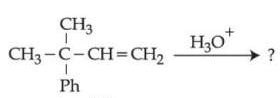 product formed is:


