
Match the Items List-I and List-II: Choose the correct answer from the options given below:List-I List-II (A) Instantaneous Rate (I) Rate constant (B) Average Rate (II) Rate law (C) Mathematical expression for rate of reaction in terms of concentration of reactants (III) Short interval of time (D) Rate of reaction for zero-order reaction is equal to (IV) Long direction of time
(A)-(III), (B)-(IV), (C)-(II), (D)-(I)
Understanding Chemical Reaction Rates
This question asks us to match fundamental concepts related to the rate of a chemical reaction from List-I with their appropriate descriptions or definitions in List-II. Let's analyze each item in List-I and find its correct match in List-II.
Analyzing List-I Items and Finding Matches
We will go through each item in List-I and explain why it matches a specific item in List-II.
-
(A) Instantaneous Rate: The instantaneous rate of reaction is the rate at a specific moment in time. This rate is determined by measuring the change in concentration of a reactant or product over a very, very short time interval.
- This definition directly corresponds to the concept of a "Short interval of time" from List-II.
- Therefore, (A) matches (III).
-
(B) Average Rate: The average rate of reaction is the rate calculated over a relatively longer period of time. It is the total change in concentration of a reactant or product divided by the total time taken for that change.
- This definition aligns with measuring the rate over a "Long direction of time" (or long duration of time) from List-II.
- Therefore, (B) matches (IV).
-
(C) Mathematical expression for rate of reaction in terms of concentration of reactants: This expression shows how the rate of a reaction depends on the concentrations of the reactants. This mathematical relationship is known as the Rate Law of the reaction.
- This is the precise definition of the "Rate law" from List-II.
- Therefore, (C) matches (II).
-
(D) Rate of reaction for zero-order reaction is equal to: For a zero-order reaction, the rate of the reaction is independent of the concentration of the reactants. The rate is constant throughout the reaction, and this constant value is equal to the rate constant (\(k\)) for the reaction. The rate law for a zero-order reaction A \(\rightarrow\) Products is given by:
- Rate \(=\) \(k\) \([A]^0\) \(=\) \(k\)
- Thus, the rate of a zero-order reaction is equal to the "Rate constant" from List-II.
- Therefore, (D) matches (I).
Summary of Matching
Based on the analysis, the correct matching pairs are:
- (A) Instantaneous Rate \(\rightarrow\) (III) Short interval of time
- (B) Average Rate \(\rightarrow\) (IV) Long direction of time
- (C) Mathematical expression for rate of reaction in terms of concentration of reactants \(\rightarrow\) (II) Rate law
- (D) Rate of reaction for zero-order reaction is equal to \(\rightarrow\) (I) Rate constant
This gives us the combination (A)-(III), (B)-(IV), (C)-(II), (D)-(I).
Revision Table: Matching Reaction Rate Concepts
| List-I Concept | List-II Description | Match |
|---|---|---|
| (A) Instantaneous Rate | (III) Short interval of time | (A)-(III) |
| (B) Average Rate | (IV) Long direction of time | (B)-(IV) |
| (C) Mathematical expression for rate of reaction in terms of concentration of reactants | (II) Rate law | (C)-(II) |
| (D) Rate of reaction for zero-order reaction is equal to | (I) Rate constant | (D)-(I) |
Additional Information: Chemical Kinetics Concepts
Understanding reaction rates is a key part of chemical kinetics. Here's a bit more detail on the concepts involved:
- Rate of Reaction: Defined as the change in concentration of a reactant or product per unit time. It can be expressed as \(\frac{\Delta[\text{Concentration}]}{\Delta t}\) (average rate) or \(\frac{d[\text{Concentration}]}{dt}\) (instantaneous rate).
- Rate Law: An equation that relates the rate of a reaction to the concentrations of reactants. For a general reaction \(aA + bB \rightarrow cC + dD\), the rate law is typically written as Rate \(=\) \(k[A]^x[B]^y\), where \(k\) is the rate constant, and \(x\) and \(y\) are the orders of the reaction with respect to reactants A and B, respectively, determined experimentally.
- Order of Reaction: The sum of the exponents of the concentration terms in the rate law (\(x+y\) in the example above). It indicates how the reaction rate is affected by the concentration of each reactant. A zero-order reaction has an overall order of 0.
- Rate Constant (\(k\)): The proportionality constant in the rate law. Its value is specific for a given reaction at a particular temperature and pressure. It represents the rate of the reaction when all reactant concentrations are 1 M (if units are molarity). Its units vary depending on the overall order of the reaction.
These concepts are fundamental to predicting how fast a reaction will proceed under different conditions.
Important Questions from Chemical Kinetics
A reaction takes 30 minutes to complete 50% of the reaction and takes 45 minutes to complete 75% of the reaction. The order of the reaction is:
Ferric oxide in blast furnace's upper half is mainly reduced by:
If time taken for a first-order reaction to get 90% complete is 24 min, its t99.9% will be:
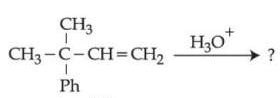 product formed is:
Identify the correct relation between the molar mass of solute and Ebullioscopic constant.


