
Measuring Thermocouple Output with Instruments
A thermocouple is a sensor commonly used for temperature measurement. It operates on the principle of the Seebeck effect, generating a small voltage, known as electromotive force (EMF), when there is a temperature difference across its two dissimilar metal conductors. The magnitude of this voltage is proportional to the temperature.
The question asks for the device used to measure this specific electrical output (voltage) from a thermocouple. Understanding the nature of the thermocouple's output is key to selecting the correct measuring instrument.
Analyzing Device Options for Thermocouple Measurement
Let's examine each option provided:
- Potentiometer: A potentiometer is a precision instrument used for measuring electrical potential difference (voltage). It works by comparing the unknown voltage with a known voltage source, often achieving high accuracy by requiring minimal current draw from the source being measured. This characteristic makes it suitable for measuring the relatively small and sensitive voltage output from a thermocouple.
- Phase detector: This device is used to determine the phase difference between two signals, typically in electronics and communication systems. It is not designed for measuring the absolute voltage output of a sensor like a thermocouple.
- Thermometers: While many thermometers incorporate thermocouples as their internal temperature-sensing element, a thermometer itself provides a temperature reading. The question specifically asks for the device to measure the *electrical output* of the thermocouple, not the final temperature reading derived from it.
- Accelerometer: An accelerometer is a device that measures acceleration or vibration. It has no relevance to measuring the voltage produced by a thermocouple.
Conclusion on Measuring Thermocouple Voltage
Based on the function of each device, the potentiometer is the most appropriate instrument among the choices for measuring the voltage output ($\mathcal{E}$) generated by a thermocouple. Its ability to measure voltage accurately, especially low voltages, without significantly loading the thermocouple makes it a suitable choice for this task.
Important Questions from Capacitive Transducers
The dynamic characteristics of capacitive transducers are similar to those of
An air filled parallel plate electrostatic actuator is shown in the figure. The area of each capacitor plate is $100 \mu m \times 100 \mu m$. The distance between the plates $d_0 = 1 \mu m$ when both the capacitor charge and spring restoring force are zero as shown in Figure (a). A linear spring of constant $k=0.01 N/m$ is connected to the movable plate. When charge is supplied to the capacitor using a current source, the top plate moves as shown in Figure (b). The magnitude of minimum charge (Q) required to momentarily close the gap between the plates is _________ $\times 10^{-14} C$ (rounded off to two decimal places).
Note: Assume a full range of motion is possible for the top plate and there is no fringe capacitance. The permittivity of free space is $\epsilon_0 =8.85\times 10^{-12} F/m$ and relative permittivity of air ($\epsilon_r$) is 1.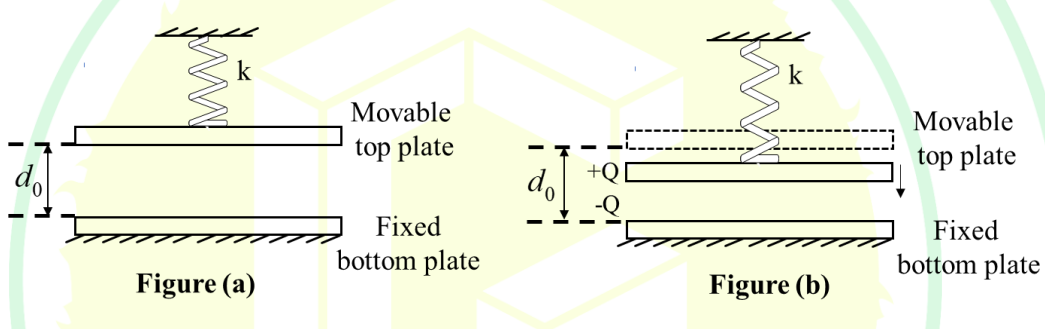
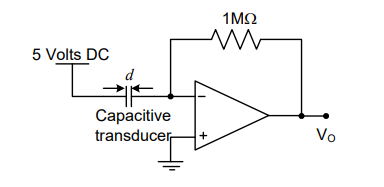
A capacitive motion transducer circuit is shown. The gap $d$ between the parallel plates of the capacitor is varied as $d(t)=10^{-3}[1+0.1\sin(1000\pi t)]$ m. If the value of the capacitance is 2pF at $t = 0$ ms, the output voltage $V_o$ at $t = 2$ ms is
- A differential push-pull type capacitive displacement sensor (nominal capacitance $C_0 = 0.01 \text{ }\mu F$) is connected in two adjacent arms of an ac bridge in such a way that the output voltage of the bridge is independent of the frequency of the supply voltage. Supply to the bridge is $1\text{V}$ at $1 \text{ kHz}$, and two equal resistances ($R = 3.9 \text{ k}\Omega$) are placed in the other two arms of the bridge. The bridge sensitivity is
A parallel plate capacitive displacement sensor has a plate area of $2\text{ cm}^2$. The air gap between the plates is decreased by $0.1\text{ mm}$ from an initial value of $0.5\text{ mm}$. The percentage change in the capacitance value is ______ %.
(Assume permittivity as $\epsilon_0 = 8.854 \times 10^{-12}\text{ F/m}$)


