
Consider the following Three Address code sample for solving the questions:
100: t1 = y+2
101: initial = x/t1
102: limit = 10
103: if i > j goto 105
104: goto 111
105: if num > b goto 107
106: goto 111
107: num = limit-1
108: b = y+2
109: i = i - num
110: goto 103
111: j = i - num
112: k= j+b
Understanding Three Address Code Leaders
This solution explains how to identify the leaders (also known as leading statements) in a given sample of Three Address Code (TAC). Leaders are crucial for defining basic blocks, which are fundamental units in compiler design for control flow analysis and optimization.
What is Three Address Code (TAC)?
Three Address Code (TAC) is an intermediate representation (IR) form used in compilers. Each instruction in TAC generally has at most three operands (two source operands and one destination operand). It simplifies complex expressions into a sequence of simple statements.
What are Basic Blocks and Leaders?
A basic block is a straight-line sequence of code that has exactly one entry point and one exit point. Control flow can only enter the block at the beginning and leave at the end, without any jumps in or out of the middle of the block.
The leaders are the first statements of the basic blocks. They are identified based on the control flow of the program. Specifically, the leaders are:
- The very first statement of the code.
- Any statement that is the target of a jump instruction (conditional or unconditional).
- Any statement that immediately follows a conditional jump instruction (and is not the target of that jump).
Identifying Leaders in the Given TAC Sample
Let's analyze the provided Three Address Code step by step to find the leaders:
| Line No. | TAC Instruction | Reason for being a Leader |
| $100$ | $t1 = y + 2$ | First instruction of the entire code. Starts the first basic block. |
| $101$ | $initial = x / t1$ | Part of the first basic block. Not a leader. |
| $102$ | $limit = 10$ | Part of the first basic block. Not a leader. |
| $103$ | $if i > j goto 105$ | Target of jump from line 110. Starts a new basic block. |
| $104$ | $goto 111$ | Instruction immediately following a conditional jump (line 103). It's not the target ($105$) of the jump in line 103. Starts a new basic block. |
| $105$ | $if num > b goto 107$ | Target of jump from line 103. Starts a new basic block. |
| $106$ | $goto 111$ | Instruction immediately following a conditional jump (line 105). It's not the target ($107$) of the jump in line 105. Starts a new basic block. |
| $107$ | $num = limit - 1$ | Target of jump from line 105. Starts a new basic block. |
| $108$ | $b = y + 2$ | Part of the basic block starting at $107$. Not a leader. |
| $109$ | $i = i - num$ | Part of the basic block starting at $107$. Not a leader. |
| $110$ | $goto 103$ | This is an unconditional jump instruction. The block it belongs to ends here. It doesn't start a new block itself based on the leader rules. |
| $111$ | $j = i - num$ | Target of jumps from line 104 and line 106. Starts a new basic block. |
| $112$ | $k = j + b$ | Part of the basic block starting at $111$. This is the last instruction; it doesn't start a new block. Not a leader. |
Conclusion: Identified Leaders
Based on the analysis of the control flow:
- The first instruction is $100$.
- Targets of jumps are $103$ (from line 110), $105$ (from line 103), $107$ (from line 105), and $111$ (from lines 104 and 106).
- Instructions immediately following conditional jumps are $104$ (after line 103) and $106$ (after line 105).
Combining these identified statements, the set of leaders for the given Three Address Code is:
$100, 103, 104, 105, 106, 107, 111$
Important Questions from Code Optimization
Consider the control flow graph given below.
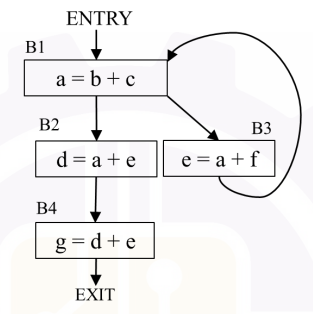
Which one of the following options is the set of live variables at the exit point of each basic block?- Which of the following is the correct High level code for the given TAC in the passage
- What all blocks does Block 3 & Block 5 dominate in the Flow graph for the TAC given in the passage?
- Match the LIST-I with LIST-II
LIST-I Input LIST-II Compiler Phase A. Syntax Tree I. Code Generator B. Character Stream II. Syntax Analyzer C. Intermediate Representation III. Semantic Analyzer D. Token Stream IV. Lexical Analyzer - In _______, the bodies of the two loops are merged together to form a single loop provided that they do not make any references to each other.


