
What are Ohmic Losses in a Transformer?
The losses generated due to variation in current passing through the windings
Understanding Ohmic Losses in a Transformer
Transformers are essential components in electrical power systems, used to change voltage levels. During their operation, transformers experience various types of energy losses. One significant type of loss is known as Ohmic Loss, also commonly referred to as Copper Loss.
What Causes Ohmic Losses?
Ohmic Losses occur due to the resistance of the windings in both the primary and secondary coils of the transformer. When current flows through these windings, which are made of conducting wire (usually copper or aluminum), heat is dissipated. This heat dissipation is a form of energy loss.
The fundamental principle governing Ohmic Losses is Joule's law of heating, which states that the power dissipated as heat in a conductor is proportional to the square of the current flowing through it and the resistance of the conductor. Mathematically, this loss in a winding can be expressed as:
\(P_{loss} = I^2 R\)
Where:
- \(P_{loss}\) is the power loss (Ohmic Loss)
- \(I\) is the current flowing through the winding
- \(R\) is the resistance of the winding
Since the resistance \(R\) of the windings is essentially constant for a given temperature (or changes slowly with temperature), the Ohmic Loss is directly dependent on the square of the current \(I\). The current flowing through the transformer windings varies significantly depending on the load connected to the secondary side. A higher load draws more current, leading to increased Ohmic Losses.
Analyzing the Options
Let's examine the provided options in the context of Ohmic Losses in a transformer:
- Option 1: The losses generated due to variation in current passing through the windings
This option accurately describes Ohmic Losses. As explained, these losses are proportional to the square of the current, and since the load current varies, the Ohmic Losses also vary accordingly. They are directly caused by the current flowing against the winding resistance. - Option 2: The losses generated due to variation in flux passing through the windings
Losses related to the variation in magnetic flux in the transformer core are known as Core Losses or Iron Losses. These include Hysteresis Losses (due to magnetization and demagnetization cycles of the core material) and Eddy Current Losses (induced currents in the core). Ohmic Losses are distinct from Core Losses. - Option 3: Iron Loss
As mentioned above, Iron Loss is the collective term for Hysteresis and Eddy Current Losses occurring in the transformer core. This is a different category of loss than Ohmic Loss (Copper Loss), which occurs in the windings. - Option 4: The losses due to varying electric field
Losses due to varying electric fields typically refer to dielectric losses in the insulating materials within the transformer. While these losses exist, they are usually very small compared to Ohmic Losses and Iron Losses and are not what is commonly referred to as Ohmic Losses in the context of transformer operation.
Based on the analysis, Option 1 correctly identifies Ohmic Losses as being related to the variation in current passing through the windings.
Summary of Transformer Losses
Transformers primarily experience two types of losses:
| Type of Loss | Location | Cause | Dependence |
|---|---|---|---|
| Ohmic Loss (Copper Loss) | Windings (Primary & Secondary) | Resistance of windings and current flow | Varies with square of load current (\(I^2 R\)) |
| Iron Loss (Core Loss) | Core | Alternating magnetic flux | Constant for constant voltage & frequency (Includes Hysteresis & Eddy Current losses) |
Conclusion
Ohmic Losses in a transformer are the power dissipated as heat in the windings due to the flow of current against the winding resistance. These losses are proportional to the square of the current and therefore vary with the load current. The correct description aligns with the losses generated due to the current flowing through the resistance of the windings, which varies with the load.
Revision Table: Transformer Losses Overview
| Loss Type | Symbol | Caused by | Location | Variability | Formula Basis |
|---|---|---|---|---|---|
| Ohmic Loss (Copper Loss) | \(P_{cu}\) | Current flow through winding resistance | Windings | Varies with load (current) | \(I^2 R\) |
| Iron Loss (Core Loss) | \(P_{fe}\) | Alternating flux in core | Core | Mostly constant (at fixed V, f) | Hysteresis + Eddy Current |
Additional Information: Reducing Transformer Losses
Minimizing transformer losses is crucial for efficiency and economic operation. Different strategies are employed to reduce Ohmic Losses and Iron Losses:
- Reducing Ohmic Losses:
Use thicker wires (lower resistance \(R\)) for windings, especially in high-current applications. Design transformers to operate closer to peak efficiency points. Ensure good cooling to prevent temperature rise, which could increase resistance. - Reducing Iron Losses:
Use high-quality core materials with low hysteresis loss (e.g., grain-oriented silicon steel). Laminate the core (stack thin sheets insulated from each other) to increase resistance to eddy current flow, thereby reducing eddy current losses. Use thinner laminations for higher frequencies.
Understanding these loss mechanisms is vital for transformer design, operation, and maintenance.
Similar Questions
To measure Voltage, Current is passed through _______.
A digital multimeter can measure _______.
The output waveform of an integrator in a function generator is ______.
Adder Circuit can be used as a Subtractor circuit by using _________.
Lead acid batteries consist of flat lead plates immersed in a pool of _______.
Which device can detect a physical quantity and convert it into an electrical signal?
Identify the temperature sensor which is not used in process industries.
Which instrument is used to measure the insulation resistance of an electric circuit relative to earth?
Generally, wiring a solar controller to a battery storage station is done using a _______.
The internal Vref voltage of IC723 is
Important Questions from Miscellaneous
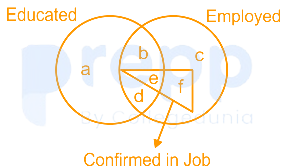
Read the given figure and find the region representing persons who are educated and employed but not confirmed in job.
The magazine in which Mahatma Gandhi mentioned what he wanted the Constitution to do is:
Which gas shields the surface of the earth from ultraviolet radiation from the sun?
Which event is marked as an Intangible Cultural Heritage of Humanity by UNESCO?
Who has been conferred with the rank of the Commander of the Order of the British Empire in 2018?



