Two statements are given followed by two conclusions numbered I and II. Assuming the statements to be true, even if they seem to be at variance from commonly known facts, decide which of the conclusions logically follow(s) from the statements. Statements: All Shirts are Cottons. Some Shirts are Nets. Conclusions: I. All Nets are Shirts. II. Some Nets are Cottons.
Only conclusion II follows.
All shirts are Cottons. This is a universal affirmative statement. Some shirts are Nets. This is a particular affirmative statement. Conclusion I: All Nets are Shirts. This is a universal affirmative statement and is not logically followed from the given statements. Conclusion II: Some Nets are Cottons. This is a particular affirmative statement and is logically followed from the given statements. Hence, only conclusion II follows.
Important Questions from Cube and Dice
Four friends J, Q, B and Z rolled the dice in alphabetical order.
The scores were:
1st round: 3, 2, 5, 2
2nd round: 1, 5, 1, 4
3rd round: 4, 2, 1, 1
If each point on the dice would get 10 points, who won the maximum points after 3 rounds?
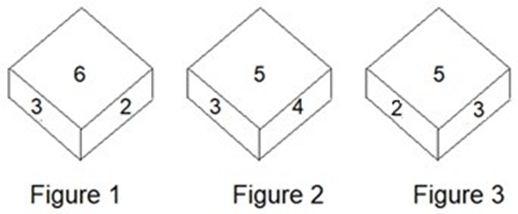
Six numbers, 1, 2, 3, 4, 5, and 6, are written on the different faces of a dice. Three different positions of the same dice are shown (Figures 1-3). Find the number on the face opposite to the face showing ‘3’.
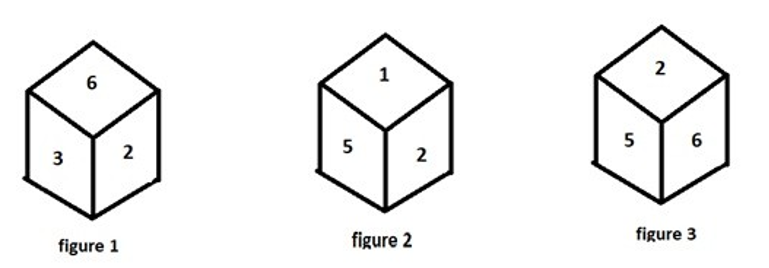
1, 2, 3, 4, 5, and 6 are written on different faces of a dice. Three different positions of the same dice are shown below. Find the number on the face opposite to the one showing ‘6’.
Which of the following interchanges of signs would make the given equation correct?
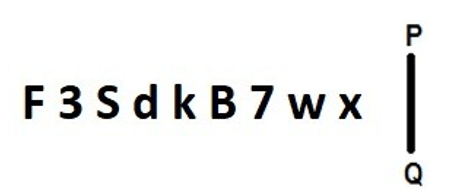
7 − 4 × 40 ÷ 5 + 6 = 51Select the correct mirror image of the given figure when the mirror is placed at PQ as shown below.