
Two poles, 15 m and 30 m in height, stand upright in a playground. If their feet are 36 m apart, then find the distance between their tops.
39 m
Finding the Distance Between the Tops of Two Vertical Poles
This problem involves two vertical poles of different heights standing upright in a playground. We are given the heights of the poles and the horizontal distance between their feet. We need to find the distance between their tops.
Let's represent the two poles as vertical lines. Let the height of the first pole be \(h_1 = 15\) m and the height of the second pole be \(h_2 = 30\) m. The horizontal distance between their feet is given as \(d = 36\) m.
Imagine a line connecting the tops of the two poles. This line forms the hypotenuse of a right-angled triangle. The horizontal distance between the feet (\(d\)) forms one leg of this triangle, and the vertical difference in height between the tops forms the other leg.
Calculating the Vertical Difference in Height
The vertical difference in height between the tops of the poles is the difference between their heights:
\(\Delta h = h_2 - h_1 = 30 \text{ m} - 15 \text{ m} = 15 \text{ m}\)
So, one leg of our right-angled triangle has a length of 15 m (the vertical difference). The other leg is the horizontal distance between the feet, which is 36 m.
Applying the Pythagorean Theorem
We have a right-angled triangle with legs of lengths 15 m and 36 m. The distance between the tops of the poles is the hypotenuse of this triangle. According to the Pythagorean theorem, in a right-angled triangle, the square of the hypotenuse (c) is equal to the sum of the squares of the other two sides (a and b):
\(c^2 = a^2 + b^2\)
Let the distance between the tops be \(D\). Here, \(a = 15\) m and \(b = 36\) m. So, we have:
\(D^2 = (15 \text{ m})^2 + (36 \text{ m})^2\)
Let's calculate the squares:
- \(15^2 = 15 \times 15 = 225\)
- \(36^2 = 36 \times 36 = 1296\)
Now, add these values:
\(D^2 = 225 + 1296\)
\(D^2 = 1521\)
To find \(D\), we need to take the square root of 1521:
\(D = \sqrt{1521}\)
The square root of 1521 is 39.
\(D = 39 \text{ m}\)
Thus, the distance between the tops of the two poles is 39 m.
| Measurement | Value |
|---|---|
| Height of Pole 1 (\(h_1\)) | 15 m |
| Height of Pole 2 (\(h_2\)) | 30 m |
| Horizontal Distance Between Feet (\(d\)) | 36 m |
| Vertical Difference in Height (\(\Delta h\)) | 15 m |
| Distance Between Tops (\(D\)) | 39 m |
Conclusion
By forming a right-angled triangle with the horizontal distance between the poles and the vertical difference in their heights, we could use the Pythagorean theorem to find the distance between their tops. The calculated distance is 39 m.
Revision Table: Poles and Distance Calculation
| Concept | Description | Application Here |
| Pythagorean Theorem | \(a^2 + b^2 = c^2\) for a right triangle | Used to find the distance (hypotenuse) |
| Vertical Distance | Difference in heights of poles | One leg of the triangle (15m) |
| Horizontal Distance | Distance between feet of poles | Other leg of the triangle (36m) |
Additional Information: Pythagorean Theorem in Geometry Problems
The Pythagorean theorem is a fundamental concept in Euclidean geometry. It states that the area of the square whose side is the hypotenuse (the side opposite the right angle) is equal to the sum of the areas of the squares on the other two sides (the legs). This theorem is extremely useful in finding unknown side lengths in right-angled triangles when two sides are known.
- The theorem only applies to right-angled triangles.
- The side opposite the right angle is always the hypotenuse, and it is the longest side.
- The other two sides are called legs or cathetus.
- Common Pythagorean triples (integer side lengths) include (3, 4, 5), (5, 12, 13), (8, 15, 17), and (7, 24, 25). The numbers in this problem (15, 36, 39) are a multiple of (5, 12, 13) since \(15 = 3 \times 5\), \(36 = 3 \times 12\), and \(39 = 3 \times 13\). Recognizing these triples can sometimes speed up calculations.
- The theorem can be used to find the distance between two points in a coordinate plane.
Important Questions from Triangles
How many triangles are there in the given figure?
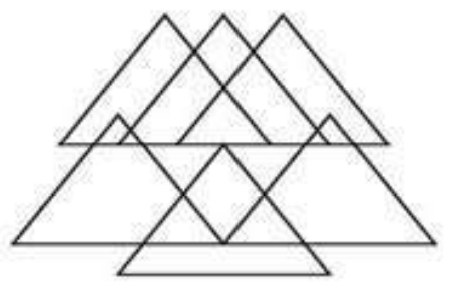
How many triangles are there in the given figure?
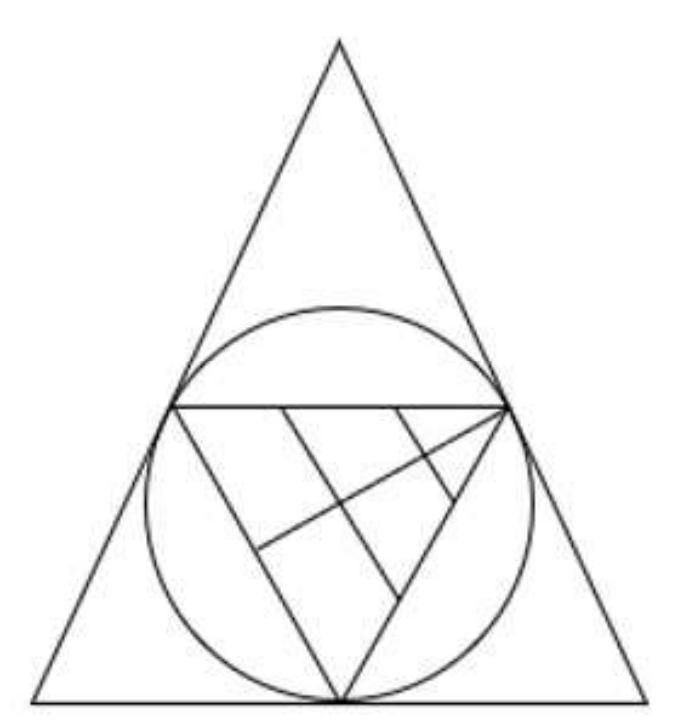
Find the area (in square cm) of a right angled triangle whose altitude is 7 cm less than its base and its hypotenuse is 17 cm.
In ΔABC, if ∠A = 70° and ∠B = 70°, find the measure of exterior angle A.
Two similar triangles are \( \triangle ABC \) and \( \triangle LMN \). If the area of \( \triangle ABC = 25 \) cm², the area of \( \triangle LMN = 36 \) cm², and BC = 2.5 cm, then the measure of MN (in cm) is:


