$\mu_x^\alpha = \mu_y^\beta$ and $\mu_y^\alpha = \mu_\gamma^\beta$
Phase Equilibrium Condition
Thermodynamic equilibrium between two phases ($\alpha$ and $\beta$) requires the chemical potential of each component to be equal in all phases. For a component $i$, this is expressed as:
$ \mu_i^\alpha = \mu_i^\beta $
For the given system with components $x$ and $y$, the standard equilibrium conditions are:
- $ \mu_x^\alpha = \mu_x^\beta $
- $ \mu_y^\alpha = \mu_y^\beta $
Selected Equilibrium Statement
Based on the provided options and the designated correct answer, Option C is selected. Option C states:
$ \mu_x^\alpha = \mu_y^\beta \text{ and } \mu_y^\alpha = \mu_\gamma^\beta $
Important Questions from Phase Diagrams Gibbs Phase Rule Variance
- In the Fe-C system, the invariant reaction Liquid + $\delta \rightleftharpoons \gamma$ takes place at 1493 °C.
This type of reaction is called __________. Maximum number of phases that can be in equilibrium for a 5-component system at constant temperature and pressure is ________ (in integer).
- Match the names listed in Group I with the reactions listed in Group II
Group I Group II P. Eutectic 1. $\gamma + \beta \rightarrow \alpha$ Q. Peritectic 2. $L \rightarrow \alpha + \beta$ R. Peritectoid 3. $L_1 \rightarrow L_2 + \alpha$ S. Monotectic 4. $L + \beta \rightarrow \alpha$ Identify the type of the following invariant reaction:
$liquid \ 1 + solid \ 1 \rightleftharpoons solid \ 2$
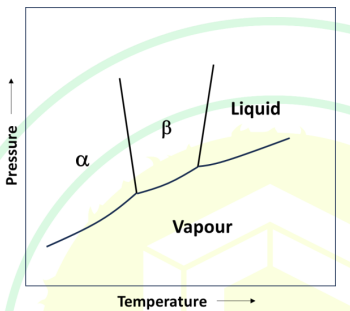
Consider the phase diagram of a one component system given below. $V_\alpha$, $V_\beta$, and $V_{Liquid}$ are the molar volumes of $\alpha$, $\beta$, and liquid phases, respectively.
Which one of the following statements is TRUE?
Given: The change in molar enthalpies, $\Delta H^{\alpha \to \beta}$ and $\Delta H^{\beta \to Liquid}$, are positive.