
Consider the phase diagram of a one component system given below. $V_\alpha$, $V_\beta$, and $V_{Liquid}$ are the molar volumes of $\alpha$, $\beta$, and liquid phases, respectively.
Which one of the following statements is TRUE?
Given: The change in molar enthalpies, $\Delta H^{\alpha \to \beta}$ and $\Delta H^{\beta \to Liquid}$, are positive.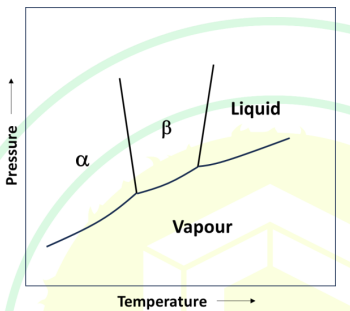
To determine the correct option, let's analyze the changes in phases in terms of volume and enthalpy using the phase diagram and the given data:
1. **Phase Diagram Analysis**: The phase diagram shows the transition lines for the phases $\alpha$, $\beta$, and liquid. Given that both changes in molar enthalpy ($\Delta H^{\alpha \to \beta}$ and $\Delta H^{\beta \to Liquid}$) are positive, these transitions are endothermic, meaning they require heat input.
2. **Volume Change Considerations**: For an endothermic process during phase transition, the general expectation is that the system absorbs heat to facilitate an increase in disorder, often leading to an increase in volume from one phase to another, especially from solid to liquid. The transitions indicate increases in molar volumes.
3. **Evaluate Each Transition**:
- From $\alpha$ to $\beta$: The positive $\Delta H^{\alpha \to \beta}$ implies $\alpha \to \beta$ is endothermic. Under typical conditions, volume of $\beta$ is slightly larger than volume of $\alpha$, but could also decrease depending on bonding.
- From $\beta$ to Liquid: The transition to liquid turns a more packed solid into a less structured liquid, usually increasing volume.
4. **Conclusion from Diagram and Data**:
- True Statement: \(V_\alpha > V_\beta\) and \(V_\beta < V_{Liquid}\).
- Why? Typically for solids in the $\alpha \to \beta$ transformation, volume may decrease due to closer atomic packing. The liquid phase should have a higher volume since it is less densely packed compared to any solid phase.
Therefore, the correct answer is the statement that \(V_\alpha > V_\beta\) and \(V_\beta < V_{Liquid}\).
Important Questions from Phase Diagrams Gibbs Phase Rule Variance
- In the Fe-C system, the invariant reaction Liquid + $\delta \rightleftharpoons \gamma$ takes place at 1493 °C.
This type of reaction is called __________. Maximum number of phases that can be in equilibrium for a 5-component system at constant temperature and pressure is ________ (in integer).
- Match the names listed in Group I with the reactions listed in Group II
Group I Group II P. Eutectic 1. $\gamma + \beta \rightarrow \alpha$ Q. Peritectic 2. $L \rightarrow \alpha + \beta$ R. Peritectoid 3. $L_1 \rightarrow L_2 + \alpha$ S. Monotectic 4. $L + \beta \rightarrow \alpha$ Identify the type of the following invariant reaction:
$liquid \ 1 + solid \ 1 \rightleftharpoons solid \ 2$
- Two phases $\alpha$ and $\beta$ are in thermodynamic equilibrium. If x and y are the only components present in the phases $\alpha$ and $\beta$ and if $\mu_i^j$ represents the chemical potential of component i in phase j, then the condition for equilibrium is


