Group I Group II P. Eutectic 1. $\gamma + \beta \rightarrow \alpha$ Q. Peritectic 2. $L \rightarrow \alpha + \beta$ R. Peritectoid 3. $L_1 \rightarrow L_2 + \alpha$ S. Monotectic 4. $L + \beta \rightarrow \alpha$
Phase Transformation Matching
This question requires matching specific types of phase transformations (Group I) with their corresponding reaction equations (Group II). Understanding the definitions of each transformation is key.
Matching Definitions and Reactions
- P. Eutectic: A reaction where a liquid phase transforms into two solid phases upon cooling. The general equation is $L \rightarrow \alpha + \beta$. This matches reaction 2.
- Q. Peritectic: A reaction where a liquid phase reacts with a solid phase to form a different solid phase upon cooling. The general equation is $L + \beta \rightarrow \alpha$. This matches reaction 4.
- R. Peritectoid: A reaction where two solid phases react to form a different solid phase upon cooling. The general equation is $\gamma + \beta \rightarrow \alpha$. This matches reaction 1.
- S. Monotectic: A reaction where a liquid phase transforms into another liquid phase and a solid phase upon cooling. The general equation is $L_1 \rightarrow L_2 + \alpha$. This matches reaction 3.
Summary of Matches
Based on the definitions:
- P (Eutectic) matches with 2 ($L \rightarrow \alpha + \beta$)
- Q (Peritectic) matches with 4 ($L + \beta \rightarrow \alpha$)
- R (Peritectoid) matches with 1 ($\gamma + \beta \rightarrow \alpha$)
- S (Monotectic) matches with 3 ($L_1 \rightarrow L_2 + \alpha$)
Therefore, the correct matching is P-2, Q-4, R-1, S-3.
Important Questions from Phase Diagrams Gibbs Phase Rule Variance
- In the Fe-C system, the invariant reaction Liquid + $\delta \rightleftharpoons \gamma$ takes place at 1493 °C.
This type of reaction is called __________. Maximum number of phases that can be in equilibrium for a 5-component system at constant temperature and pressure is ________ (in integer).
Identify the type of the following invariant reaction:
$liquid \ 1 + solid \ 1 \rightleftharpoons solid \ 2$
- Two phases $\alpha$ and $\beta$ are in thermodynamic equilibrium. If x and y are the only components present in the phases $\alpha$ and $\beta$ and if $\mu_i^j$ represents the chemical potential of component i in phase j, then the condition for equilibrium is
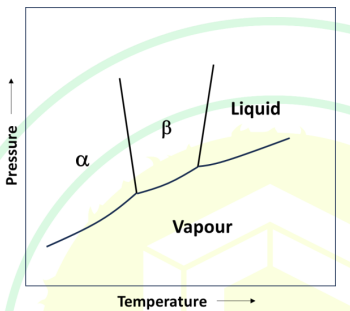
Consider the phase diagram of a one component system given below. $V_\alpha$, $V_\beta$, and $V_{Liquid}$ are the molar volumes of $\alpha$, $\beta$, and liquid phases, respectively.
Which one of the following statements is TRUE?
Given: The change in molar enthalpies, $\Delta H^{\alpha \to \beta}$ and $\Delta H^{\beta \to Liquid}$, are positive.