
Two parallel plates are separated by a distance d/2 as shown in the figure below :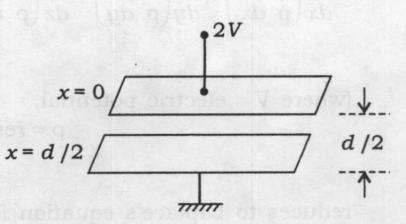
The surface charge density at $x = 0$ is
The problem involves two parallel plates with one plate at potential 2V and the other grounded. The task is to find the surface charge density at x = 0, which is the plane at potential 2V.
To solve for the surface charge density, \sigma, we use the relationship with the electric field E and the potential difference V:
The electric field E between two plates is given by the derivative of the potential difference with respect to distance:
E = \frac{V}{d/2}
Given the potential difference is 2V and the plates are separated by d/2, the electric field becomes:
E = \frac{2V}{d/2} = \frac{4V}{d}
The surface charge density \sigma is related to the electric field by:
\sigma = \varepsilon_0 E
Substituting for E:
\sigma = \varepsilon_0 \times \frac{4V}{d}
Therefore, the surface charge density at x = 0 is:
\sigma = \frac{4V \varepsilon_0}{d}
Thus, the correct answer is \frac{4V\varepsilon_0}{d}. This is consistent with option A.
Important Questions from Electrostatics
- An infinite plane carries a uniform surface charge $\sigma$. Its electric field is
(where $\hat{n}$ is a unit normal vector pointing away from the surface) - The electric field in polystyrene (relative permittivity = 2.55) filling the space between the plates of a parallel-plate capacitor is $10 \ kV/m$. The distance between the plates is $1.5 \ mm$. The potential difference between the plates is


