
Capacitor Potential Difference Calculation
This problem requires calculating the potential difference ($V$) between the plates of a parallel-plate capacitor. We are given the electric field strength ($E$) within the capacitor and the distance ($d$) between its plates.
Electric Field Potential Relation
For a uniform electric field, such as the one ideally present between the plates of a parallel-plate capacitor, the relationship between potential difference ($V$), electric field strength ($E$), and distance ($d$) is defined by the equation:
$$ V = E \times d $$
Here:
- $V$ represents the potential difference measured in Volts (V).
- $E$ is the electric field strength measured in Volts per meter (V/m).
- $d$ is the separation distance measured in meters (m).
Capacitor Given Values
The details provided in the question are:
- Electric Field Strength, $E = 10 \ kV/m$.
- Plate Separation Distance, $d = 1.5 \ mm$.
- The dielectric material is polystyrene with relative permittivity $\epsilon_r = 2.55$. This information describes the capacitor's construction but is not needed for calculating the potential difference when the electric field strength is already known.
Distance and Field Unit Conversions
To use the formula $V = E \times d$, we must convert the given values to standard SI units:
- Electric Field Conversion: Convert kilovolts per meter ($kV/m$) to Volts per meter ($V/m$).
$$ E = 10 \ kV/m = 10 \times 10^3 \ V/m $$
- Distance Conversion: Convert millimeters ($mm$) to meters ($m$).
$$ d = 1.5 \ mm = 1.5 \times 10^{-3} \ m $$
Potential Difference Calculation Steps
Substitute the values in SI units into the formula:
- Plug in the converted values for $E$ and $d$:
$$ V = (10 \times 10^3 \ V/m) \times (1.5 \times 10^{-3} \ m) $$
- Multiply the values:
$$ V = (10 \times 1.5) \times (10^3 \times 10^{-3}) \ V $$
$$ V = 15 \times 10^{3 + (-3)} \ V $$
$$ V = 15 \times 10^0 \ V $$
- Simplify the expression:
$$ V = 15 \times 1 \ V $$
$$ V = 15 \ V $$
Final Potential Difference
The calculation shows that the potential difference between the plates of the parallel-plate capacitor is $15 \ V$.
Important Questions from Electrostatics
- An infinite plane carries a uniform surface charge $\sigma$. Its electric field is
(where $\hat{n}$ is a unit normal vector pointing away from the surface) Two parallel plates are separated by a distance d/2 as shown in the figure below :
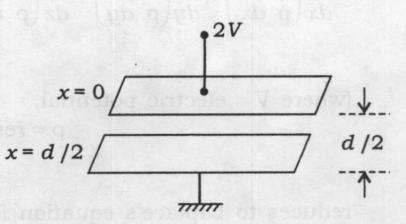
The surface charge density at $x = 0$ is


