
(where $\hat{n}$ is a unit normal vector pointing away from the surface)
Understanding the Electric Field of an Infinite Charged Plane
This question asks us to determine the electric field produced by an infinite plane that carries a uniform surface charge density denoted by $\sigma$. The electric field is represented vectorially, using $\hat{n}$ as the unit normal vector pointing away from the surface.
Applying Gauss's Law
To find the electric field of an infinite plane with uniform charge distribution, a common and effective method is using Gauss's Law. Gauss's Law relates the electric flux through a closed surface to the charge enclosed within that surface.
Let's consider a cylindrical Gaussian surface. We choose this shape such that its axis is perpendicular to the infinite plane and it penetrates the plane, with one end cap on each side of the plane. Let the area of each end cap be $A$.
- The electric field $\vec{E}$ is perpendicular to the plane and points outwards from it (assuming $\sigma$ is positive).
- The direction of the electric field is parallel to the normal vector $\hat{n}$ on each side.
- The electric field lines are parallel to the curved surface of the cylinder.
According to Gauss's Law:
$$ \oint \vec{E} \cdot d\vec{A} = \frac{q_{enc}}{\varepsilon_0} $$
Where:
- $\oint \vec{E} \cdot d\vec{A}$ is the total electric flux through the closed Gaussian surface.
- $q_{enc}$ is the net charge enclosed by the surface.
- $\varepsilon_0$ is the permittivity of free space.
Calculating the Flux
The electric flux calculation involves considering the flux through the different parts of the Gaussian surface:
- Flux through the end caps: Since $\vec{E}$ is perpendicular to the end caps and points outwards, the flux through each cap is $E \cdot A$. As there are two caps, the total flux through the caps is $2EA$.
- Flux through the curved surface: The electric field lines are parallel to the curved surface. Therefore, the angle between $\vec{E}$ and the area vector $d\vec{A}$ is $90^\circ$, making the dot product $\vec{E} \cdot d\vec{A} = 0$. So, the flux through the curved surface is zero.
The total electric flux is therefore $2EA$.
Calculating the Enclosed Charge
The charge enclosed ($q_{enc}$) within the Gaussian surface is the surface charge density $\sigma$ multiplied by the area $A$ of the plane enclosed by the cylinder:
$$ q_{enc} = \sigma A $$
Determining the Electric Field
Now, substituting the flux and enclosed charge into Gauss's Law:
$$ 2EA = \frac{\sigma A}{\varepsilon_0} $$
We can cancel the area $A$ from both sides (since $A$ is non-zero):
$$ 2E = \frac{\sigma}{\varepsilon_0} $$
Solving for the magnitude of the electric field $E$:
$$ E = \frac{\sigma}{2\varepsilon_0} $$
Vector Form of the Electric Field
The question specifies that $\hat{n}$ is the unit normal vector pointing *away* from the surface. The electric field from a positively charged plane points perpendicularly away from it. Therefore, the electric field vector $\vec{E}$ is:
$$ \vec{E} = E \hat{n} = \frac{\sigma}{2\varepsilon_0} \hat{n} $$
Comparing with Options
Let's compare this result with the given options:
- Option 1: $\frac{\sigma}{2\varepsilon_0} \hat{n}$
- Option 2: $\frac{\sigma}{\varepsilon_0} \hat{n}$
- Option 3: $\frac{\sigma}{4\varepsilon_0} \hat{n}$
- Option 4: $\frac{\sigma}{8\varepsilon_0} \hat{n}$
Our derived electric field matches Option 1 exactly.
Final Answer
The electric field of an infinite plane carrying a uniform surface charge $\sigma$ is correctly represented by Option 1.
Important Questions from Electrostatics
- The electric field in polystyrene (relative permittivity = 2.55) filling the space between the plates of a parallel-plate capacitor is $10 \ kV/m$. The distance between the plates is $1.5 \ mm$. The potential difference between the plates is
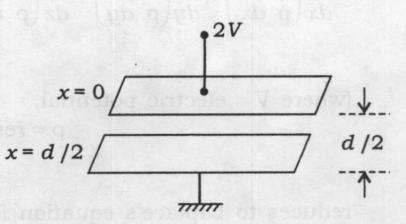
Two parallel plates are separated by a distance d/2 as shown in the figure below :
The surface charge density at $x = 0$ is


