
Two cars P and Q are travelling on a straight path and are $60$ m apart as shown in the figure; Car P is moving with a constant velocity of $36$ kmph, while car Q is moving at a constant velocity of $18$ kmph. At this instant, the driver in car P applies the brake and collision occurs with car Q after $30$ seconds. Assuming uniform deceleration due to braking, which one of the following is the CORRECT velocity (in m/s) of the car P just before the collision?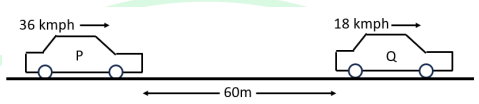
To solve this problem, we need to determine the velocity of car P just before the collision. Let's break down the steps:
- Convert the velocities from km/hr to m/s.
- Velocity of car P: \(36 \, \text{kmph} = \frac{36 \times 1000}{3600} = 10 \, \text{m/s}\)
- Velocity of car Q: \(18 \, \text{kmph} = \frac{18 \times 1000}{3600} = 5 \, \text{m/s}\)
- Calculate the relative velocity of car P with respect to car Q.
- Relative velocity, \(v_{\text{rel}} = v_P - v_Q = 10 - 5 = 5 \, \text{m/s}\)
- Determine the relative distance to be closed for a collision to occur.
- Relative distance = 60 m
- Use the formula for relative motion under uniform acceleration:
- The time taken for collision, \(t = 30 \, \text{s}\).
- Apply the equation of motion for car P:
- The equation \(v = u + at\) can be rearranged to find final velocity \(v\) just before collision.
- Let \(a\) be the deceleration. From \(s = ut + \frac{1}{2}at^2\), where \(s = 60 \, \text{m}\) and \(u = \text{initial relative velocity} = 5 \, \text{m/s}\),
- \(60 = 5 \times 30 + \frac{1}{2} \times a \times (30)^2 \Rightarrow 60 = 150 + 450a \Rightarrow a = -0.2 \, \text{m/s}^2\)
- Using \(v = u + at\) for car P:
- \(v = 10 + (-0.2) \times 30 = 4 \, \text{m/s}\)
Thus, the velocity of car P just before the collision is 4 m/s.
Important Questions from Speed Distance and Time
- A car is moving on a horizontal surface in a straight line with a constant velocity of 3 m/s. A ball is thrown vertically upwards at time $t = 0$ from the top of the moving car with a velocity of 20 m/s. The acceleration due to gravity is 10 m/s$^2$.
At what value(s) of time $t$ in second(s), the ball is at a height of 15 m from the top of the moving car? - Velocity of an object fired directly in upward direction is given by $V = 80 – 32 \ t$, where $t$ (time) is in seconds. When will the velocity be between 32 m/sec and 64 m/sec?
In a 500 m race, P and Q have speeds in the ratio of 3: 4. Q starts the race when P has already covered 140 m.
What is the distance between P and Q (in m) when P wins the race?- An automobile travels from city A to city B and returns to city A by the same route. The speed of the vehicle during the onward and return journeys were constant at 60 km/h and 90 km/h, respectively. What is the average speed in km/h for the entire journey?
Two cars start at the same time from the same location and go in the same direction. The speed of the first car is 50 km/h and the speed of the second car is 60 km/h. The number of hours it takes for the distance between the two cars to be 20 km is ___________.


