To reduce the slope distance (S) to an equivalent horizontal distance (H) as shown in the figure given below, the following independent observations were taken. $S = 29.95 \text{ m } \pm 0.01 \text{ m}$; $\theta = 4°30^′ \pm 10^′$ T he required precision of computed horizontal distance is $\pm 0.005 \text{ m}$. Assume a "balanced accuracy” where the contribution to precision of the horizontal distance comes equally from the slope distance and angle measurements. The minimum number of angle observations to achieve the desired precision is (Given 1 radian = 206265 seconds)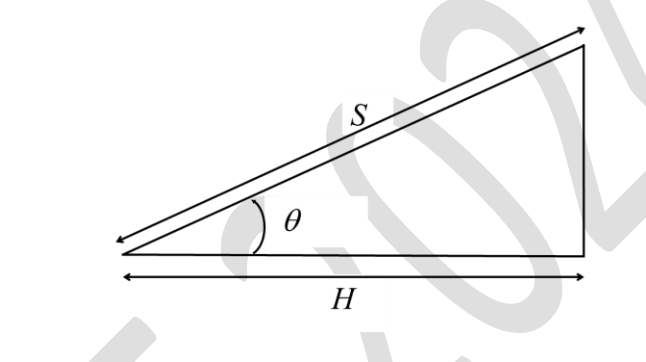
To find the minimum number of angle observations required to achieve the desired precision in the horizontal distance \(H\), we need to consider both the precision of the slope distance \(S\) and the angle \(\theta\).
Given:
- \(S = 29.95 \, \text{m} \pm 0.01 \, \text{m}\)
- \(\theta = 4^\circ 30' \pm 10'\)
- Desired precision of \(H\): \(\pm 0.005 \, \text{m}\)
The formula for converting slope distance to horizontal distance is:
- \(H = S \cdot \cos(\theta)\)
Using error propagation for \(H\):
- \(\Delta H = \sqrt{ \left( \frac{\partial H}{\partial S} \cdot \Delta S \right)^2 + \left( \frac{\partial H}{\partial \theta} \cdot \Delta \theta \right)^2 }\)
Partial derivatives:
- \(\frac{\partial H}{\partial S} = \cos(\theta)\)
- \(\frac{\partial H}{\partial \theta} = -S \cdot \sin(\theta)\)
Given \(\Delta H = 0.005 \, \text{m}\) and assuming balanced accuracy, the contributions from \(\Delta S\) and \(\Delta \theta\) should be equal:
- \(0.005 = \sqrt{2} \cdot \Delta S \cdot \cos(\theta)\)
- \(0.005 = \sqrt{2} \cdot (-S \cdot \sin(\theta) \cdot \Delta \theta)\)
Calculating for angle \(\theta\):
- \(\sin(\theta) \approx \theta \text{ (in radians) } = \left(4.5 \times \frac{\pi}{180}\right)\)
- The angle precision component can be calculated using radian conversion: \(1 \text{ radian} = 206265 \text{ seconds}\)
Substitute and solve for \(\Delta \theta\):
- \(\Delta \theta = \frac{0.005}{\sqrt{2} \cdot 29.95 \cdot \text{sin}(\theta)}\)
Using these calculations and finding \(\Delta \theta\), convert seconds to observation counts. Results conclude a minimum of 4 angle observations are required.
Thus, the correct answer is:
- Option 4
Here is the illustration provided:
Important Questions from Error Analysis
The calibration graph between absorbance and the concentration of chromate (CrO$_4^{2-}$) in a water sample is shown in the figure.
The equation of the line is $y = 0.8003x + 0.0055$.
For an absorbance of 0.35 in a water sample, the estimated Cr(VI) concentration is ______ mg/L (rounded off to two decimal places).
Use the atomic weight (g/mol) of Cr and O as 52 and 16, respectively.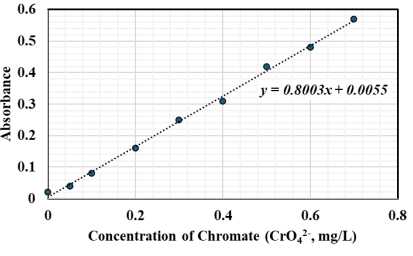
A digital counter increments its count every $0.1\ \mu\text{s}$. The counter is used in an instrument to measure frequency. The counter is operated for one period of the input signal to the instrument to measure its frequency. The input signal is approximately at $100\text{ kHz}$. The maximum error in the measured frequency is _____ kHz.
(rounded off to the nearest integer)
- The length of a highway was measured in 10 equal sections. If the precision of the individual section measurements is $\sigma$, then what is the precision of the measured length of the highway?
- A trapezoidal land parcel for a residential plot measures 10.335 m in the south, 13.971 m in the north, 5.047 m in the west and 6.302 m in the east directions. The north and south sides are perpendicular to the western side of the plot, making the eastern side skewed. Given the lengths of the sides are measured with a precision of 1 mm, the precision of the area of the plot calculated from these measurements is __________ $\text{m}^2$ (Rounded off to two decimal values).
Hint: Area of a trapezium $= \left(\frac{\text{sum of parallel sides}}{2}\right) \times \text{height}$ Identify the type of error the instrument shows as in the given figure.