
Problem Setup: Candidates and Passing Criteria
We are given the total number of candidates and the number of candidates who answered specific questions correctly. The passing threshold is answering at least 2 out of 3 questions correctly.
- Total Candidates ($N$): $6,30,000$
- Candidates answering A correctly ($|A|$): $3,30,000$
- Candidates answering B correctly ($|B|$): $2,50,000$
- Candidates answering C correctly ($|C|$): $2,60,000$
- Candidates answering A and B correctly ($|A \cap B|$): $1,00,000$
- Candidates answering B and C correctly ($|B \cap C|$): $90,000$
- Candidates answering A and C correctly ($|A \cap C|$): $80,000$
- Let $x$ be the number of candidates answering all three questions correctly ($|A \cap B \cap C|$).
- We are given that the number answering all correctly is equal to the number answering none correctly. So, number answering none ($|(A \cup B \cup C)'|$) is also $x$.
Calculate Number Answering All/None
Using the Principle of Inclusion-Exclusion for three sets:
$|A \cup B \cup C| = |A| + |B| + |C| - (|A \cap B| + |B \cap C| + |A \cap C|) + |A \cap B \cap C|$
Substitute the given values:
$|A \cup B \cup C| = 3,30,000 + 2,50,000 + 2,60,000 - (1,00,000 + 90,000 + 80,000) + x$
$|A \cup B \cup C| = 8,40,000 - 2,70,000 + x$
$|A \cup B \cup C| = 5,70,000 + x$
The total number of candidates is the sum of those in the union ($A \cup B \cup C$) and those outside the union (none):
$N = |A \cup B \cup C| + |(A \cup B \cup C)'|$
$6,30,000 = (5,70,000 + x) + x$
$6,30,000 = 5,70,000 + 2x$
$2x = 6,30,000 - 5,70,000$
$2x = 60,000$
$x = 30,000$
So, $30,000$ candidates answered all questions correctly, and $30,000$ answered none correctly.
Calculate Number Passed
Candidates pass if they answer at least 2 questions correctly. This includes those who answered exactly 2 correctly and those who answered exactly 3 correctly.
- Exactly 3 correct: This is $|A \cap B \cap C| = x = 30,000$.
- Exactly 2 correct: This is calculated by taking the intersections of two sets and subtracting those who got all three correct.
- A and B only: $|A \cap B| - |A \cap B \cap C| = 1,00,000 - 30,000 = 70,000$
- B and C only: $|B \cap C| - |A \cap B \cap C| = 90,000 - 30,000 = 60,000$
- A and C only: $|A \cap C| - |A \cap B \cap C| = 80,000 - 30,000 = 50,000$
Total candidates who passed = (Exactly 2 correct) + (Exactly 3 correct)
Total Passed = $1,80,000 + 30,000 = 2,10,000$.
Calculate Number Failed
The number of candidates who failed is the total number of candidates minus the number who passed.
Failed Candidates = Total Candidates - Total Passed
Failed Candidates = $6,30,000 - 2,10,000$
Failed Candidates = $4,20,000$
Important Questions from Venn Diagrams
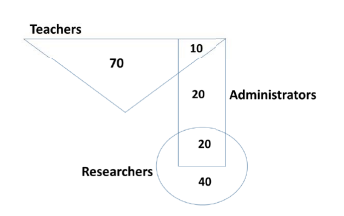
In the given diagram, teachers are represented in the triangle, researchers in the circle and administrators in the rectangle. Out of the total number of the people, the percentage of administrators shall be in the range of ___________.
Out of \(100\) textile companies, \(10\) companies are involved in spinning, weaving and chemical processing, \(25\) companies are involved in spinning and chemical processing, and \(30\) companies are involved in weaving and chemical processing. If \(65\) companies are involved in chemical processing, the number of companies involved {ONLY} in chemical processing is ________________________.
- In a class of 300 students in an M.Tech programme, each student is required to take at least one subject from the following three:
M600: Advanced Engineering Mathematics
C600: Computational Methods for Engineers
E600: Experimental Techniques for Engineers
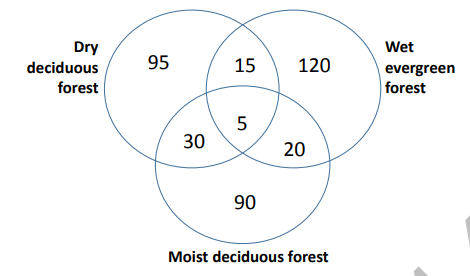
The registration data for the M.Tech class shows that 100 students have taken M600, 200 students have taken C600, and 60 students have taken E600. What is the maximum possible number of students in the class who have taken all the above three subjects? The Venn Diagram below shows numbers of species in three forest types. Which of the following statements is true?
Each row of Column-I has three items and each item is represented by a circle in Column-II. The arrangement of circles in Column-II represents the relationship among the items in Column-I.
Identify the option that has the most appropriate match between Column-I and Column-II.
Note: The figure shown are representative.
Column-I Column-II (1) Animal, Zebra, Giraffe (P) 
(2) Director, Producer, Actor (Q) 
(3) Word, Sentence, Novel (R) 
(4) Pianist, Guitarist, Instrumentalist (S) 


