
Three statements are given followed by two conclusions numbered I and II. Assuming the statements to be true, even if they seem to be at variance with commonly known facts, decide which of the conclusions logically follow(s) from the statements. Statements : No crow is a monkey. All monkeys are turtles. No turtle is a snail. Conclusions : I. Some snails being crows is a possibility. II. No turtle is a crow.
Only conclusion I follows
The least possible venn diagram has been shown below,
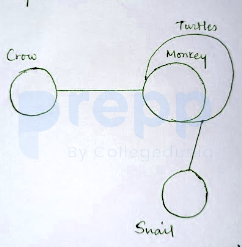
Conclusions:
I. Some snails being crows is a possibility → Follows (Because it is not definite, but it is possible).
II. No turtle is a crow → Not Follows (Because it is not definite, but it is possible).
Hence, the correct answer is "Only conclusion I follows".
Similar Questions
Two statements are given, followed by three conclusions numbered I, II and III. Assuming the statements to be true, even if they seem to be at variance with commonly known facts, decide which of the conclusions logically follow(s) from the statements.
Statements:
All teachers are engineers.
All clerks are teachers.
Conclusions:
I. Some engineers are clerks.
II. Some teachers are clerks.
III. Some clerks are not engineers.
Two statements are given followed by two conclusions numbered I and II. Assuming the statements to be true, even if they seem to be at variance with commonly known facts, decide which of the conclusions logically follow(s) from the statements.
Statements:
All keys are locks.
All locks are handles.
Conclusions:
I. Some locks are keys.
II. Some handles are keys.
Three Statements are given followed by Three conclusions numbered I, II and III. Assuming the statements to be true, even if they seem to be at variance with commonly known facts, decide which of the conclusions logically follow(s) from the statements.
Statements:
All switches are fans.
No heater is a fan.
Some wires are heaters.
Conclusions:
I. Some wires are fans.
II. No switch is a heater.
III. No wire is a switch.
Three statements are given followed by two conclusions numbered I and II. Assuming the statements to be true, even if they seem to be at variance with commonly known facts, decide which of the conclusions logically follow(s) from the statements.
Statements:
All H are G.
All V are H.
Some V are I.
Conclusions:
I. At least some G are I.
II. All I being H is a possibility.
Three Statements are given followed by Three conclusions numbered I, II and III. Assuming the statements to be true, even if they seem to be at variance with commonly known facts, decide which of the conclusions logically follow(s) from the statements.
Statements :
Some beds are chairs.
Some chairs are tables.
All tables are cupboards.
Conclusions :
I. Some tables are beds.
II. Some cupboards are chairs.
III. Some cupboards are beds.
Read the given statement(s) and conclusions carefully. Assuming that the information given in the statements is true, even if it appears to be at variance with commonly known facts, decide which of the given conclusions logically follow(s) from the statement(s).
Statements :
Some ceilings are beds.
No bed is an apple.
All dogs are beds.
Conclusions :
I. Some ceilings being dogs is a possibility.
II. No dog is an apple.
III. All beds are dogs.
IV. No ceiling is an apple.
Two statements are given followed by two conclusions numbered I and II. Assuming the statements to be true, even if they seem to be at variance with commonly known facts, decide which of the conclusions logically follow(s) from the statements.
Statements:
All keys are locks.
All locks are handles.
Conclusions:
I. All locks are keys.
II. All handles are keys.
Two statements are given followed by two conclusions numbered I and II. Assuming the statements to be true, even if they seem to be at variance with commonly known facts, decide which of the conclusions logically follow(s) from the statements.
Statements:
Some windows are doors.
No window is a cupboard.
Conclusions:
I. No cupboard is a door.
II. Some doors are definitely not cupboard.
Three Statements are given followed by Four conclusions numbered I, II, III and IV. Assuming the statements to be true, even if they seem to be at variance with commonly known facts, decide which of the conclusions logically follow(s) from the statements.
Statements:
Some copies are pillows.
Some pillows are laptops.
Some laptops are pens.
Conclusions:
I. Some copies are laptops.
II. Some pillows are pens.
III. Some pens are laptops.
IV. Some pens are pillows.
Read the given statements and conclusions carefully. Assuming that the information given in the statements is true, even if it appears to be at variance with commonly known facts, decide which of the given conclusions logically follow(s) from the statements.
Statements:
1) Some trousers are pants.
2) All pants are jeans.
3) All jeans are coats.
Conclusions:
I. All pants are coats.
II. At least some trousers are jeans
Important Questions from Conventional Syllogism
In this question, three statements followed by two conclusions numbered I and II have been given. You have to take the given statements to be true even if they seem to be at variance from the commonly facts and then decide which of the given conclusions logically follows from the given statements disregarding commonly known facts.
Statements: Some flats are apartments.
No apartment is a hall.
Some halls are rooms.
Conclusions: I. At least some rooms are flats.
II. No apartment is a room.
Read the given statements and conclusions carefully. Assuming that the information given in the statements is true, even if it appears to be at variance with commonly known facts, decide which of the given conclusions logically follow(s) from the statements.
Statements:
I. Some blue are red.
II. Some green are red.
Conclusions:
I. No blue is green.
II. No red is green.
Given below are two statements, Consider these statements to be true even if they seem factuality absurd, Read the conclusions and then decide which of the given conclusions logically follow(s) from the given statements?
Statements :
1. All vases are flowers.
2. No flowers is a plant.
Conclusions :
1. No vases is a plant.
2. Some plant are vases
In the question two statements are given, followed by three conclusions, I, II and III. You have to consider the statements to be true even if it seems to be at variance from commonly known facts. You have to decide which of the given conclusions, if any, follows from the given statements.
Statement 1 : Some cars are scooters.
Statement 2 : All scooters are buses.
Conclusion I : Some scooters are cars.
Conclusion II : Some buses are cars.
Conclusion III : All cars are buses.
Read the given statements and conclusions carefully. Assuming that the information in the statement is true even if they appear to be at variance with commonly known facts, choose the conclusion that logically follows from the statement beyond reasonable doubt.
Statement:-
1. Some dogs are cats.
2. All cats are birds.
Conclusion:-
1. Some dogs are birds.
2. No cat is dog.



