(i) A parent and his/her child cannot be on the same team.
(ii) A match can feature at most one parent and his/her child, that is, a maximum of one parent-child pair can play in a match.
The following matches were played:TEAM 1 TEAM 2 MATCH 1 P and X Q and R MATCH 2 P and R X and Y MATCH 3 R and X Q and Y
Which one of the following options is correct?
Understanding the Badminton Tournament Setup
The puzzle involves five players: children P, Q, R and adults X, Y. We are given specific conditions:
- X and Y are parents to two of the children (P, Q, R).
- The child of X is different from the child of Y.
- Exactly one child among P, Q, R does not have a parent playing in the tournament.
- Rule (i): A parent and their child cannot be on the same team.
- Rule (ii): A match can feature at most one parent-child pair (meaning a parent and their child cannot both be playing in the same match).
Deducing Parent-Child Relationships
We analyze the given matches using the rules:
- Match 1 (P+X vs Q+R): Since X is paired with P, Rule (i) implies X cannot be P's parent.
- Match 3 (R+X vs Q+Y): Since X is paired with R, Rule (i) implies X cannot be R's parent.
- As X is a parent to one of the children (P, Q, R) and cannot be parent to P or R, it logically follows that X is the parent of Q.
- Match 1 (P+X vs Q+R): Since Y is paired with R, Rule (i) implies Y cannot be R's parent.
- Match 3 (R+X vs Q+Y): Since Y is paired with Q, Rule (i) implies Y cannot be Q's parent.
- We know X is Parent(Q). Y is also a parent to one child. Since Y cannot be Parent(Q) or Parent(R), Y must be the parent of P.
Identifying the Unparented Child
From our deductions:
- X is Parent(Q).
- Y is Parent(P).
- The condition states exactly one child does not have a parent playing. Since Q and P have playing parents (X and Y), R must be the child with no parent playing.
Verifying All Conditions
We confirm the deduced parentage (Parent(Q)=X, Parent(P)=Y, R is unparented) against the matches and rules:
- Rule (i) Compliance: Q is not with X, and P is not with Y. This holds true based on the team assignments in the matches.
- Rule (ii) Compliance: Check each match for featured parent-child pairs (parent and child both playing):
- Match 1 (P+X vs Q+R): Pair (X,Q) is featured (X & Q playing). Pair (Y,P) is not featured (Y not playing). Total = 1. Valid.
- Match 2 (P+R vs X+Y): Pair (X,Q) is not featured (Q not playing). Pair (Y,P) is featured (Y & P playing). Total = 1. Valid.
- Match 3 (R+X vs Q+Y): Pair (X,Q) is featured (X & Q playing). Pair (Y,P) is not featured (P not playing). Total = 1. Valid.
- All conditions are met with R being the unparented child.
Important Questions from Puzzles
In the 4 x 4 array shown below, each cell of the first three rows has either a cross (X) or a number.
1 X 4 3 X 5 5 4 3 X 6 X
The number in a cell represents the count of the immediate neighboring cells (left, right, top, bottom, diagonals) NOT having a cross (X). Given that the last row has no crosses (X), the sum of the four numbers to be filled in the last row is- Rishi and Swathi are students of Class 5. Pavan and Tanvi are students of Class 4. Rishi and Pavan are boys. Swathi and Tanvi are girls. The four students played a total of three games of chess. The games were played one after another. A player who lost a game did not participate in any more games. It was observed that:
(i) the first game was the only game where two students of the same class played against each other,
(ii) the students of Class 5 won more games than the students of Class 4, and
(iii) the boys won two games and the girls won one game.
The student who did not lose any game is __________. - In the 2020 summer Olympics’ Javelin throw finals, Neeraj Chopra exhibited a spectacular performance to win the gold medal. The silver medal was won by Jakub Vadlejch and the bronze medal was won by Vitezlav Vesely. There were six rounds of throws with each athlete having one throw per round. The best of all the throws of each athlete is considered for the medal. Following were the observations about the throws:
i. The first and second rounds were dominated by Neeraj Chopra with a gold medal performance in his second throw, while the other two athletes did not have any medal winning throws in these rounds.
ii. The throws in the last round by both Jakub Vadlejch and Vitezlav Vesely were fouls and were not considered for scoring.
iii. After four rounds, Vitezlav Vesely was in the second position and could not improve upon his best throw in the succeeding rounds.
iv. In the fourth round, the throw by Jakub Vadlejch was the best in that round.
In which round did Vitezlav Vesely have his best throw? Students applying for hostel rooms are allotted rooms in order of seniority. Students already staying in a room will move if they get a room in their preferred list. Preferences of lower ranked applicants are ignored during allocation.
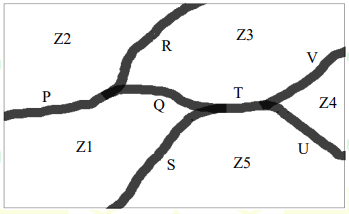
Given the data below, which room will Ajit stay in?Names Student seniority Current room Room preference list Amar 1 P R, S, Q Akbar 2 None R, S Anthony 3 Q P Ajit 4 S Q, P, R The diagram below shows a river system consisting of 7 segments, marked P, Q, R, S, T, U, and V. It splits the land into 5 zones, marked Z1, Z2, Z3, Z4, and Z5. We need to connect these zones using the least number of bridges. Out of the following options, which one is correct?
Note: The figure shown is representative.