
A certain number of men can complete a piece of work in 6k days, where k is a natural number.
By what percent should the number of men be increased so that the work can be completed in
5k days?
20%
Understanding Work and Time Problems
In work and time problems, the total amount of work is usually considered constant. The key relationship is often between the number of workers and the time taken to complete the work. Assuming each worker does work at the same rate, the number of workers and the time taken are inversely proportional.
This means if you increase the number of workers, the time taken to complete the same amount of work will decrease, and vice versa. Mathematically, this can be represented as:
$$ \text{Number of Workers} \times \text{Time} = \text{Constant Work} $$
Let's apply this concept to the given problem involving a certain number of men completing a piece of work.
Initial and Final Work Scenarios
We are given two scenarios for completing the same piece of work:
- Initial Scenario: A certain number of men complete the work in $6k$ days.
- Final Scenario: An increased number of men complete the work in $5k$ days.
Let's define the variables:
- Let $M_1$ be the initial number of men.
- Let $T_1$ be the initial time taken, which is $6k$ days.
- Let $M_2$ be the final number of men (after increasing).
- Let $T_2$ be the final time taken, which is $5k$ days.
Applying the Work-Time Formula
Since the amount of work is the same in both scenarios, we can use the relationship:
$$ M_1 \times T_1 = M_2 \times T_2 $$
Substitute the given values for the time:
$$ M_1 \times (6k) = M_2 \times (5k) $$
Assuming $k$ is a natural number, $k \ne 0$. We can cancel $k$ from both sides of the equation:
$$ 6 M_1 = 5 M_2 $$
Now, we can express $M_2$ in terms of $M_1$:
$$ M_2 = \frac{6}{5} M_1 $$
This equation tells us that the new number of men ($M_2$) is $\frac{6}{5}$ times the original number of men ($M_1$).
Calculating the Percentage Increase in Men
We need to find the percentage by which the number of men should be increased. The increase in the number of men is the difference between the final number of men and the initial number of men:
$$ \text{Increase in Men} = M_2 - M_1 $$
Substitute the expression for $M_2$ we found:
$$ \text{Increase in Men} = \frac{6}{5} M_1 - M_1 $$
To subtract $M_1$, we can write $M_1$ as $\frac{5}{5} M_1$:
$$ \text{Increase in Men} = \frac{6}{5} M_1 - \frac{5}{5} M_1 = \left(\frac{6}{5} - \frac{5}{5}\right) M_1 = \frac{1}{5} M_1 $$
The increase in the number of men is $\frac{1}{5}$ of the original number of men.
Now, to find the percentage increase, we use the formula:
$$ \text{Percentage Increase} = \frac{\text{Increase}}{\text{Original Number}} \times 100\% $$
Substitute the values:
$$ \text{Percentage Increase} = \frac{\frac{1}{5} M_1}{M_1} \times 100\% $$
Cancel out $M_1$ from the numerator and denominator:
$$ \text{Percentage Increase} = \frac{1}{5} \times 100\% $$
$$ \text{Percentage Increase} = 20\% $$
So, the number of men should be increased by 20% so that the work can be completed in $5k$ days instead of $6k$ days.
| Scenario | Number of Men | Time Taken |
|---|---|---|
| Initial | $M_1$ | $6k$ days |
| Final | $M_2 = \frac{6}{5} M_1$ | $5k$ days |
Revision Table: Work and Time Concepts
| Concept | Description | Formula |
|---|---|---|
| Total Work | Assumed constant for a specific task | Constant |
| Inverse Proportion | Number of workers and time taken are inversely related (if work rate is constant) | $M \times T = \text{Constant}$ |
| Percentage Change | Calculated as $(\text{Change} / \text{Original Value}) \times 100\%$ | $\frac{\text{Final} - \text{Initial}}{\text{Initial}} \times 100\%$ |
Additional Information: Assumptions in Work Problems
When solving work and time problems like this, we usually make certain assumptions unless stated otherwise:
- Constant Work Rate: It is assumed that all workers (men, in this case) work at the same constant rate. The rate of work for each individual does not change over time.
- Total Work is Fixed: The amount of work to be completed is the same in all scenarios being compared.
- Efficiency: Sometimes problems might introduce different efficiencies for different workers, but in this basic problem, all men are assumed to be equally efficient.
Understanding these assumptions helps in correctly applying the inverse proportionality relationship between the number of workers and the time taken.
Important Questions from Miscellaneous Topics
- In communication the word 'Haptics' signifies :
- Which of the following statements best defines the scope of semiotics?
The compound interest on Rs. 75,000 for three years, at successive interest rates of 4%, 6% and 9% for each year respectively is:
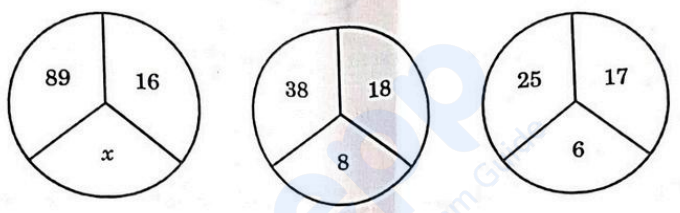
The value of x in the following figures is :
When a child reaches adolescence, there is apt to be a conflict between the parents and the child, since
the latter considers himself to be by now quite capable of managing his own affairs, while the former
are filled with parental solicitude, which is often a disguise for love of power. Parents consider, usually,
that the various moral problems which arise in adolescence are peculiarly their province. The options
they express, however, are so dogmatic that the young seldom confide in them, and usually go their
own way in secret.


