
Solution: Determining Bragg Angle and Crystal Structure
The problem requires calculating the Bragg angle ($2\theta$) and identifying the crystal structure of a cubic material using X-ray diffraction data, specifically noting that the $(111)$ plane yields the lowest angle reflection.
1. Identify Crystal Structure
The condition that the $(111)$ plane gives the reflection at the lowest $2\theta$ value (meaning the largest $d$-spacing) is key to identifying the crystal structure. According to Bragg's Law, $2d\sin\theta = n\lambda$, a smaller $2\theta$ corresponds to a larger $d$. We examine the allowed reflections for common cubic structures:
- Face-Centered Cubic (FCC): Reflections are permitted only when Miller indices $(hkl)$ are either all even or all odd. The allowed reflections, in order of increasing angle, begin with $(111), (200), (220), \dots$. Thus, $(111)$ is the first allowed reflection.
- Body-Centered Cubic (BCC): Reflections are permitted only when the sum of Miller indices $(h+k+l)$ is even. The allowed reflections begin with $(110), (200), (211), \dots$. The $(111)$ reflection ($1+1+1=3$) is forbidden.
Since the $(111)$ plane is associated with the lowest angle reflection, the crystal structure must be Face-Centered Cubic (FCC).
2. Calculate Lattice Parameter ($a$) for FCC
In an FCC lattice, atoms touch along the face diagonal. The relationship between the atomic radius ($r$) and the lattice parameter ($a$) is derived from the face diagonal length, $\sqrt{2}a = 4r$. Solving for $a$: $a = \frac{4r}{\sqrt{2}} = 2\sqrt{2}r$. Given atomic radius $r = 1.56$ Å. $a = 2\sqrt{2} \times 1.56 \text{ Å} \approx 4.411 \text{ Å}$.
3. Calculate Interplanar Spacing ($d_{111}$)
For any cubic crystal system, the interplanar spacing $d_{hkl}$ is related to the lattice parameter $a$ by the formula: $d_{hkl} = \frac{a}{\sqrt{h^2+k^2+l^2}}$. For the $(111)$ plane: $d_{111} = \frac{a}{\sqrt{1^2+1^2+1^2}} = \frac{a}{\sqrt{3}}$. Using the calculated lattice parameter $a \approx 4.411$ Å: $d_{111} = \frac{4.411 \text{ Å}}{\sqrt{3}} \approx 2.547 \text{ Å}$.
4. Calculate Bragg Angle ($2\theta$)
Apply Bragg's Law, $2d\sin\theta = n\lambda$. We assume the first-order reflection ($n=1$). The wavelength of the X-ray used is $\lambda = 0.78$ Å. $2 \times d_{111} \times \sin\theta = 1 \times \lambda$ $2 \times (2.547 \text{ Å}) \times \sin\theta = 0.78 \text{ Å}$ $5.094 \text{ Å} \times \sin\theta = 0.78 \text{ Å}$ $\sin\theta = \frac{0.78 \text{ Å}}{5.094 \text{ Å}} \approx 0.15312$ Calculate the angle $\theta$: $\theta = \arcsin(0.15312) \approx 8.815^\circ$. The question asks for the value of $2\theta$: $2\theta = 2 \times \theta \approx 2 \times 8.815^\circ = 17.63^\circ$.
5. Final Result and Rounding
Rounding the calculated $2\theta$ value to one decimal place gives $17.6^\circ$. The crystal structure was identified as Face-Centered Cubic (FCC). Thus, the Bragg angle and crystal structure are $17.6^\circ$ and face centered cubic, respectively.
Important Questions from X-ray Diffraction Bragg's Laue Method
A neutron beam with a wave vector $\vec{k}$ and an energy 20.4 meV diffracts from a crystal with an outgoing wave vector $\vec{k}'$. One of the diffraction peaks is observed for the reciprocal lattice vector $\vec{G}$ of magnitude $3.14 \text{ Å}^{-1}$. What is the diffraction angle in degrees (rounded off to the nearest integer) that $\vec{k}$ makes with the plane? (Use mass of neutron = $1.67 \times 10^{-27}$ $\text{ Kg}$)
- In an X-Ray diffraction experiment on a solid with FCC structure, five diffraction peaks corresponding to (111), (200), (220), (311) and (222) planes are observed using $1.54 \mathring{A}$ X-rays. On using $3 \mathring{A}$ X-rays on the same solid, the number of observed peaks will be ________.
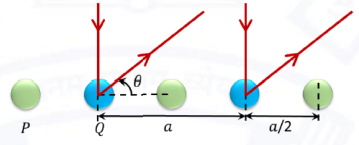
As shown in the figure, X-ray diffraction pattern is obtained from a diatomic chain of atoms P and Q. The diffraction condition is given by $a \cos \theta = n \lambda$, where $n$ is the order of the diffraction peak. Here, $a$ is the lattice constant and $ \lambda $ is the wavelength of the X-rays. Assume that atomic form factors and resolution of the instrument do not depend on $ \theta $. Then, the intensity of the diffraction peaks is
Neutrons moving with speed $10^3 \text{ m/s}$ are used for the determination of crystal structure. If the Bragg angle for the first order diffraction is $30^\circ$, the interplanar spacing of the crystal is ________ Å.
(Given: $m_n = 1.675 \times 10^{-27} \text{ kg}$, $h = 6.626 \times 10^{-34} \text{ J.s}$)
- A metal with body centered cubic (bcc) structure shows the first (i.e. smallest angle) diffraction peak at a Bragg angle of $\theta=30^\circ$. The wavelength of X-ray used is 2.1 Å. The volume of the PRIMITIVE unit cell of the metal is


