
BCC Structure Diffraction Analysis
This problem requires calculating the volume of the primitive unit cell for a metal with a Body Centered Cubic (BCC) structure using X-ray diffraction data. We are given the Bragg angle ($\theta$) for the first diffraction peak and the X-ray wavelength ($\lambda$).
Applying Bragg's Law
- State Bragg's Law: The relationship between the X-ray wavelength ($\lambda$), interplanar spacing ($d$), Bragg angle ($\theta$), and the order of diffraction ($n$) is given by Bragg's Law: $ n\lambda = 2d \sin\theta $
- Identify BCC First Diffraction Peak: For a BCC structure, the first diffraction peak (corresponding to the smallest angle) occurs for the Miller indices (110). The formula for interplanar spacing in a cubic crystal is: $ d_{hkl} = \frac{a}{\sqrt{h^2+k^2+l^2}} $ For the (110) plane, $h^2+k^2+l^2 = 1^2+1^2+0^2 = 2$. Therefore, the spacing for the first peak is: $ d_{110} = \frac{a}{\sqrt{2}} $
- Calculate Interplanar Spacing ($d_{110}$): Using the given values $\theta = 30^\circ$, $\lambda = 2.1$ Å, and assuming the first peak corresponds to $n=1$: $ 1 \times (2.1 \text{ Å}) = 2 \times d_{110} \times \sin(30^\circ) $ Since $\sin(30^\circ) = 0.5$: $ 2.1 = 2 \times d_{110} \times 0.5 $ $ 2.1 = d_{110} $ So, the interplanar spacing $d_{110}$ is $2.1$ Å.
Calculating Lattice Parameter and Cell Volume
- Calculate Lattice Parameter ($a$): Relate the calculated $d_{110}$ to the lattice parameter $a$: $ d_{110} = \frac{a}{\sqrt{2}} $ $ 2.1 \text{ Å} = \frac{a}{\sqrt{2}} $ $ a = 2.1 \sqrt{2} \text{ Å} $
- Calculate Conventional Unit Cell Volume ($V_{cell}$): The volume of the conventional cubic unit cell is $a^3$: $ V_{cell} = a^3 = (2.1 \sqrt{2})^3 $ $ V_{cell} = (2.1)^3 \times (\sqrt{2})^3 = 9.261 \times 2\sqrt{2} \text{ Å}^3 $ $ V_{cell} \approx 26.18 \text{ Å}^3 $
- Calculate Primitive Unit Cell Volume ($V_{primitive}$): A BCC unit cell contains two lattice points, but its primitive unit cell contains only one lattice point. The volume of the primitive unit cell is half the volume of the conventional unit cell: $ V_{primitive} = \frac{1}{2} V_{cell} $ $ V_{primitive} = \frac{1}{2} \times (2.1 \sqrt{2})^3 \approx \frac{1}{2} \times 26.18 \text{ Å}^3 $ $ V_{primitive} \approx 13.09 \text{ Å}^3 $
Rounding the result gives $13.1 \text{ Å}^3$.
Important Questions from X-ray Diffraction Bragg's Laue Method
A neutron beam with a wave vector $\vec{k}$ and an energy 20.4 meV diffracts from a crystal with an outgoing wave vector $\vec{k}'$. One of the diffraction peaks is observed for the reciprocal lattice vector $\vec{G}$ of magnitude $3.14 \text{ Å}^{-1}$. What is the diffraction angle in degrees (rounded off to the nearest integer) that $\vec{k}$ makes with the plane? (Use mass of neutron = $1.67 \times 10^{-27}$ $\text{ Kg}$)
- The X-ray diffraction pattern of a monatomic cubic crystal with rigid spherical atoms of radius $1.56$ Å shows several Bragg reflections of which the reflection appearing at the lowest $2\theta$ value is from $(111)$ plane. If the wavelength of X-ray used is $0.78$ Å, the Bragg angle (in $2\theta$, rounded off to one decimal place) corresponding to this reflection and the crystal structure, respectively, are
- In an X-Ray diffraction experiment on a solid with FCC structure, five diffraction peaks corresponding to (111), (200), (220), (311) and (222) planes are observed using $1.54 \mathring{A}$ X-rays. On using $3 \mathring{A}$ X-rays on the same solid, the number of observed peaks will be ________.
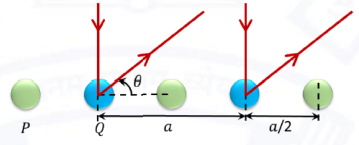
As shown in the figure, X-ray diffraction pattern is obtained from a diatomic chain of atoms P and Q. The diffraction condition is given by $a \cos \theta = n \lambda$, where $n$ is the order of the diffraction peak. Here, $a$ is the lattice constant and $ \lambda $ is the wavelength of the X-rays. Assume that atomic form factors and resolution of the instrument do not depend on $ \theta $. Then, the intensity of the diffraction peaks is
Neutrons moving with speed $10^3 \text{ m/s}$ are used for the determination of crystal structure. If the Bragg angle for the first order diffraction is $30^\circ$, the interplanar spacing of the crystal is ________ Å.
(Given: $m_n = 1.675 \times 10^{-27} \text{ kg}$, $h = 6.626 \times 10^{-34} \text{ J.s}$)


