
A neutron beam with a wave vector $\vec{k}$ and an energy 20.4 meV diffracts from a crystal with an outgoing wave vector $\vec{k}'$. One of the diffraction peaks is observed for the reciprocal lattice vector $\vec{G}$ of magnitude $3.14 \text{ Å}^{-1}$. What is the diffraction angle in degrees (rounded off to the nearest integer) that $\vec{k}$ makes with the plane? (Use mass of neutron = $1.67 \times 10^{-27}$ $\text{ Kg}$)
Neutron Wave Vector Calculation
The energy of the neutron beam is given as $E = 20.4$ meV. Convert this energy to Joules: $E = 20.4 \times 10^{-3} \text{ eV} \times (1.602 \times 10^{-19} \text{ J/eV}) = 3.268 \times 10^{-21} \text{ J}$.
The neutron energy relates to its wave vector magnitude ($k = |\vec{k}|$) via $E = \frac{\hbar^2 k^2}{2m}$. Here, $m = 1.67 \times 10^{-27}$ kg is the neutron mass and $\hbar \approx 1.054 \times 10^{-34}$ J s is the reduced Planck constant.
Solve for $k$: $k = \frac{\sqrt{2mE}}{\hbar}$ $k = \frac{\sqrt{2 \times (1.67 \times 10^{-27} \text{ kg}) \times (3.268 \times 10^{-21} \text{ J})}}{1.054 \times 10^{-34} \text{ J s}}$ $k \approx \frac{\sqrt{10.918 \times 10^{-48}}}{1.054 \times 10^{-34}} \text{ m}^{-1}$ $k \approx \frac{3.304 \times 10^{-24}}{1.054 \times 10^{-34}} \text{ m}^{-1} \approx 3.135 \times 10^{10} \text{ m}^{-1}$.
Convert $k$ to Angstroms ($\text{Å}^{-1}$), noting $1 \text{ Å} = 10^{-10}$ m: $k \approx 3.135 \text{ Å}^{-1}$.
Diffraction Angle Calculation
For elastic diffraction, the relationship between the incident wave vector ($\vec{k}$), outgoing wave vector ($\vec{k}'$), and reciprocal lattice vector ($\vec{G}$) is $\vec{k}' - \vec{k} = \vec{G}$. Since $|\vec{k}| = |\vec{k}'| = k$, the magnitude squared gives $|\vec{G}|^2 = |\vec{k}'|^2 + |\vec{k}|^2 - 2\vec{k} \cdot \vec{k}'$.
Let $2\theta$ be the angle between $\vec{k}$ and $\vec{k}'$. Then $\vec{k} \cdot \vec{k}' = k^2 \cos(2\theta)$. $|\vec{G}|^2 = k^2 + k^2 - 2k^2 \cos(2\theta) = 2k^2 (1 - \cos(2\theta))$. Using the identity $1 - \cos(2\theta) = 2\sin^2(\theta)$, we get: $|\vec{G}|^2 = 2k^2 (2\sin^2(\theta)) = 4k^2 \sin^2(\theta)$. Therefore, $|\vec{G}| = 2k \sin(\theta)$. The angle $\theta$ here represents the Bragg angle, which is the angle between the incident wave vector $\vec{k}$ and the crystal planes.
Given $|\vec{G}| = 3.14 \text{ Å}^{-1}$ and calculated $k \approx 3.135 \text{ Å}^{-1}$: $3.14 \text{ Å}^{-1} = 2 \times (3.135 \text{ Å}^{-1}) \sin(\theta)$.
Solve for $\sin(\theta)$: $\sin(\theta) = \frac{3.14}{2 \times 3.135} = \frac{3.14}{6.270} \approx 0.5008$.
Find the angle $\theta$: $\theta = \arcsin(0.5008) \approx 30.05^\circ$.
Rounding to the nearest integer gives the diffraction angle as $30^\circ$.
Important Questions from X-ray Diffraction Bragg's Laue Method
- The X-ray diffraction pattern of a monatomic cubic crystal with rigid spherical atoms of radius $1.56$ Å shows several Bragg reflections of which the reflection appearing at the lowest $2\theta$ value is from $(111)$ plane. If the wavelength of X-ray used is $0.78$ Å, the Bragg angle (in $2\theta$, rounded off to one decimal place) corresponding to this reflection and the crystal structure, respectively, are
- In an X-Ray diffraction experiment on a solid with FCC structure, five diffraction peaks corresponding to (111), (200), (220), (311) and (222) planes are observed using $1.54 \mathring{A}$ X-rays. On using $3 \mathring{A}$ X-rays on the same solid, the number of observed peaks will be ________.
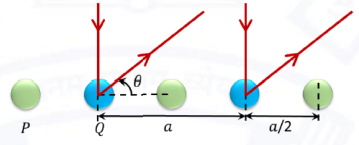
As shown in the figure, X-ray diffraction pattern is obtained from a diatomic chain of atoms P and Q. The diffraction condition is given by $a \cos \theta = n \lambda$, where $n$ is the order of the diffraction peak. Here, $a$ is the lattice constant and $ \lambda $ is the wavelength of the X-rays. Assume that atomic form factors and resolution of the instrument do not depend on $ \theta $. Then, the intensity of the diffraction peaks is
Neutrons moving with speed $10^3 \text{ m/s}$ are used for the determination of crystal structure. If the Bragg angle for the first order diffraction is $30^\circ$, the interplanar spacing of the crystal is ________ Å.
(Given: $m_n = 1.675 \times 10^{-27} \text{ kg}$, $h = 6.626 \times 10^{-34} \text{ J.s}$)
- A metal with body centered cubic (bcc) structure shows the first (i.e. smallest angle) diffraction peak at a Bragg angle of $\theta=30^\circ$. The wavelength of X-ray used is 2.1 Å. The volume of the PRIMITIVE unit cell of the metal is


