
The voltage gain of a certain amplifier without feedback is 10. With feedback its voltage gain reduces to 5. Determine its feedback factor.
β = 0.1
To determine the feedback factor ($\beta$) of an amplifier, we use the relationship between its voltage gain without feedback (open-loop gain) and its voltage gain with feedback (closed-loop gain). This problem deals with an amplifier where the voltage gain is reduced due to negative feedback, which is a common characteristic of feedback systems.
Amplifier Gain Concepts
In amplifier circuits, two important gain parameters are considered:
- Open-loop gain ($A$): This is the voltage gain of the amplifier circuit without any feedback applied. In this problem, the amplifier's voltage gain without feedback is given as $A = 10$.
- Closed-loop gain ($A_f$): This is the voltage gain of the amplifier when a feedback path is introduced. For a negative feedback system, the closed-loop gain is always less than the open-loop gain. Here, the voltage gain with feedback is given as $A_f = 5$.
The feedback factor ($\beta$) represents the fraction of the output signal that is fed back to the input. For negative feedback, the general formula relating these quantities is:
$A_f = \frac{A}{1 + A\beta}$
Where:
- $A_f$ = Closed-loop voltage gain
- $A$ = Open-loop voltage gain
- $\beta$ = Feedback factor
Feedback Factor Calculation
We are provided with the following values related to the amplifier's voltage gain and feedback:
- Open-loop voltage gain, $A = 10$
- Closed-loop voltage gain, $A_f = 5$
We need to find the feedback factor, $\beta$.
Let's substitute the given values into the formula for closed-loop gain:
$5 = \frac{10}{1 + 10\beta}$
Now, we will solve this equation for $\beta$ step-by-step:
Step 1: Multiply both sides by the denominator $(1 + 10\beta)$:
$5 \times (1 + 10\beta) = 10$
Step 2: Distribute the 5 on the left side of the equation:
$5 + 50\beta = 10$
Step 3: Subtract 5 from both sides of the equation to isolate the term with $\beta$:
$50\beta = 10 - 5$
$50\beta = 5$
Step 4: Divide both sides by 50 to find the value of $\beta$:
$\beta = \frac{5}{50}$
$\beta = \frac{1}{10}$
$\beta = 0.1$
Feedback Factor Result
The calculated feedback factor for the amplifier is $0.1$. This value indicates the fraction of the output signal that is fed back to the input to achieve the reduced voltage gain of 5 from an initial gain of 10.
The final answer is $\beta = 0.1$.
Important Questions from Feedback Amplifier
Arrange the following amplifiers in the order of maximum achievable -3dB frequency. Assume the transconductance ($g_m$) of the driver transistor (M1) same in all the circuits.
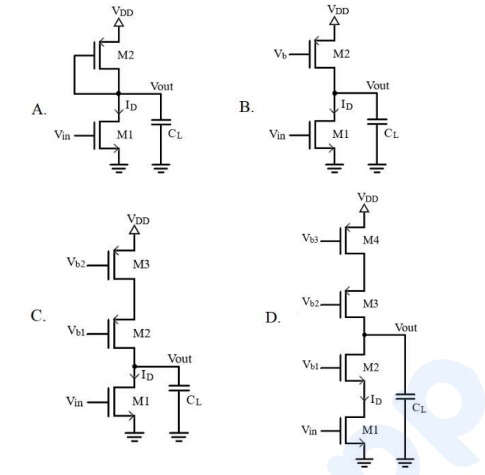
Choose the correct answer from the options given below:
Arrange the following amplifiers in the order of maximum achievable voltage gain. Assume the geometry and overdrive voltage is same for the transistor M1 in all the circuits and $R_D < <r_{o1}$.
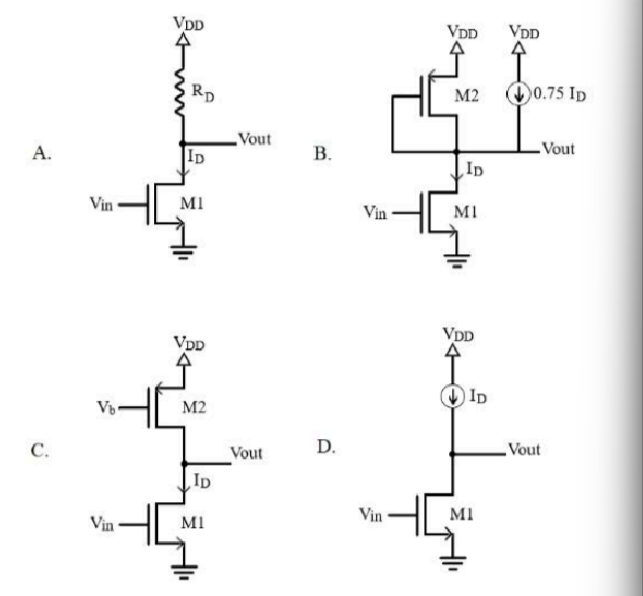
choose the correct answer from the options given below:
Match the following lists :
List – I List – II a. Voltage series feedback i. Trans resistance amplifier b. Current series feedback ii. Current shunt feedback c. Current amplifier iii. Trans-conductance d. Voltage shunt feedback iv. Voltage amplifier Codes :
Match the following :
List – I List – II a. voltage shunt negative feedback i. increase of CMRR b. constant current source differential amplifier ii. O/P voltage attenuated by a factor 1/29 c. Phase shift oscillator iii. FSK decoder d. PLL iv. decrease of O/P impedance Codes :
Negative feedback in amplifier results in
1. reduced voltage gain
2. reduced bandwidth
3. increased S/N ratio
4. reduced distortion


