
Arrange the following amplifiers in the order of maximum achievable -3dB frequency. Assume the transconductance ($g_m$) of the driver transistor (M1) same in all the circuits. Choose the correct answer from the options given below: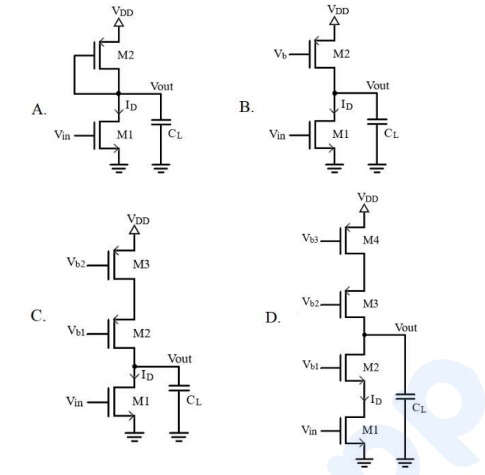
To determine the order of amplifiers based on the maximum achievable -3dB frequency, we need to analyze the circuit configurations, particularly focusing on the capacitance affecting the frequency response. The -3dB frequency is inversely related to the effective load capacitance seen by the driver transistor (\(M1\)) that affects the bandwidth. Let's analyze each configuration:
- Configuration A: This is a single-stage common-source amplifier with a load capacitor \(C_L\). The -3dB frequency is determined by the time constant \(\tau = R_{out} \cdot C_L\), where \(R_{out}\) is the output resistance. This configuration typically has a lower frequency compared to more complex stages due to higher capacitance directly affecting the output.
- Configuration B: This involves a simple cascode amplifier which increases output resistance, improving bandwidth compared to Configuration A by reducing Miller effect but still affected significantly by \(C_L\).
- Configuration C: This uses a double cascode configuration, where two cascode stages further increase the output resistance compared to Configuration B. The increased output resistance reduces effective capacitance, thus further improving bandwidth.
- Configuration D: This is a triple cascode configuration with the highest output resistance and smallest effective capacitance loading, allowing for the highest -3dB frequency. It effectively isolates parasitic capacitances, further enhancing the frequency response.
Understanding these configurations helps infer that the order of amplifiers in ascending order of the -3dB frequency is:
- D: Triple cascode (highest -3dB frequency due to reduced effective capacitance).
- C: Double cascode (moderate improvement over single cascode).
- B: Single cascode (better than single stage but less than double and triple cascode).
- A: Common-source (lowest -3dB frequency due to maximum load capacitance).
Thus, the correct order is: D, C, B, A.
Important Questions from Feedback Amplifier
Arrange the following amplifiers in the order of maximum achievable voltage gain. Assume the geometry and overdrive voltage is same for the transistor M1 in all the circuits and $R_D < <r_{o1}$.
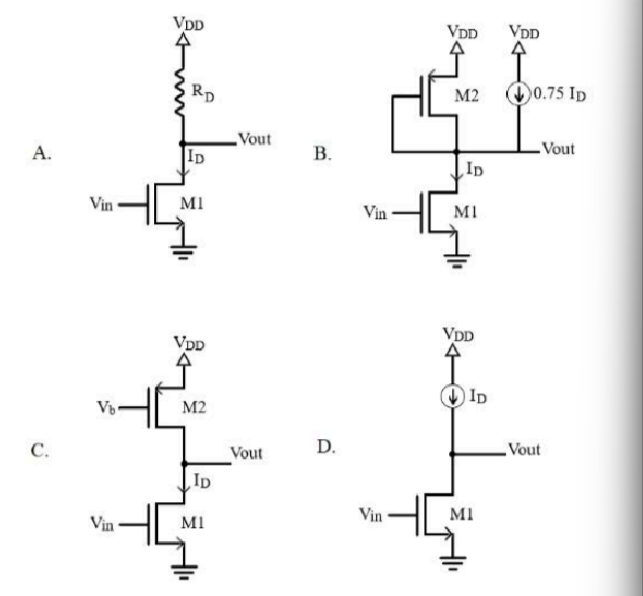
choose the correct answer from the options given below:
The voltage gain of a certain amplifier without feedback is 10. With feedback its voltage gain reduces to 5. Determine its feedback factor.
Match the following lists :
List – I List – II a. Voltage series feedback i. Trans resistance amplifier b. Current series feedback ii. Current shunt feedback c. Current amplifier iii. Trans-conductance d. Voltage shunt feedback iv. Voltage amplifier Codes :
Match the following :
List – I List – II a. voltage shunt negative feedback i. increase of CMRR b. constant current source differential amplifier ii. O/P voltage attenuated by a factor 1/29 c. Phase shift oscillator iii. FSK decoder d. PLL iv. decrease of O/P impedance Codes :
Negative feedback in amplifier results in
1. reduced voltage gain
2. reduced bandwidth
3. increased S/N ratio
4. reduced distortion


