
Tsunami Velocity Determinants Explained
The speed or velocity of a tsunami wave is primarily determined by the properties of the water it travels through, specifically the water's depth. This relationship is described by a well-known formula in fluid dynamics.
Factors Affecting Tsunami Wave Speed
- Water Depth: Tsunami velocity ($v$) is directly proportional to the square root of the water depth ($h$). The formula is: $ v = \sqrt{g \times h} $ where $g$ is the acceleration due to gravity (approximately $9.8 \, \text{m/s}^2$). This means waves travel much faster in deep ocean water and slow down significantly as they approach shallower coastal areas.
- Focal Depth: The depth at which the earthquake occurs (focal depth) influences the initial energy transfer to the water, affecting the tsunami's size and potential destructive power, but not its speed across the ocean.
- Epicentre Distance: The distance from the earthquake's origin (epicentre) to the shore affects how long it takes for the tsunami to arrive and how much its wave characteristics might change due to interaction with the seabed over distance, but it doesn't determine the instantaneous speed at a given point.
Conclusion on Velocity Factors
Based on the physics governing wave propagation in shallow water (which applies to tsunamis even in the deep ocean due to their immense wavelength), the key factor influencing the velocity is the water depth. Neither the focal depth of the earthquake nor the epicentre distance from the shore directly dictates the wave's speed across the ocean.
Important Questions from Natural Hazards
Depending on the moisture conditions and speed of mass movements shown in the diagram, identify the types of mass movements A, B, C and D
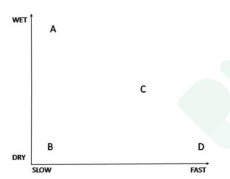
Velocity-------$\rightarrow$ Material Slow Moderate Fast Unconsolidated material B C A Rock D From the above table identify the type of mass movement
- A tsunami occurs 1000 km away from the shore in an ocean water depth of 6.25 km. The tsunami reaches the shore in about
- Which one of the following options is the best way to protect yourself from lightning if you get caught in an open field during a thunderstorm?
- Which one of the following events is caused by liquefaction?


