
Tsunami Speed Calculation
The speed of a tsunami wave depends primarily on the ocean depth. The formula for shallow water wave speed is:
$ v = \sqrt{g \times h} $
Where:
- v is the wave speed
- g is the acceleration due to gravity (approximately $9.8 \text{ m/s}^2$)
- h is the water depth
Calculating Wave Speed
Given:
- Distance ($d$) = 1000 km
- Water depth ($h$) = 6.25 km
First, convert the water depth to meters:
$ h = 6.25 \text{ km} = 6.25 \times 1000 \text{ m} = 6250 \text{ m} $
Now, calculate the wave speed using $g \approx 9.8 \text{ m/s}^2$:
$ v = \sqrt{9.8 \text{ m/s}^2 \times 6250 \text{ m}} = \sqrt{61250 \text{ m}^2/\text{s}^2} \approx 247.5 \text{ m/s} $
Determining Arrival Time
Convert the speed from m/s to km/hr for easier time calculation:
$ v \approx 247.5 \text{ m/s} \times \frac{3600 \text{ s}}{1 \text{ hr}} \times \frac{1 \text{ km}}{1000 \text{ m}} \approx 891 \text{ km/hr} $
Calculate the time taken to reach the shore using the formula Time = Distance / Speed:
$ t = \frac{d}{v} = \frac{1000 \text{ km}}{891 \text{ km/hr}} \approx 1.12 \text{ hours} $
This calculated time is approximately 1.12 hours. Among the given options, 1 hour is the closest value.
Important Questions from Natural Hazards
Depending on the moisture conditions and speed of mass movements shown in the diagram, identify the types of mass movements A, B, C and D
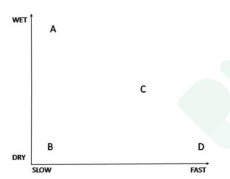
Velocity-------$\rightarrow$ Material Slow Moderate Fast Unconsolidated material B C A Rock D From the above table identify the type of mass movement
- The velocity of a tsunami wave is dependent on
- Which one of the following options is the best way to protect yourself from lightning if you get caught in an open field during a thunderstorm?
- Which one of the following events is caused by liquefaction?


