First Order Process Identification
The process transfer function is given as:
$ G(s) = \frac{K_p}{ \tau_p s+1} $
We need to identify the type of process based on this transfer function.
Analyzing the Transfer Function
The general form of a first-order system transfer function is:
$ G(s) = \frac{K}{\tau s + 1} $
Where:
- \( K \) is the process gain.
- \( \tau \) is the time constant.
- The highest power of \( s \) in the denominator is 1.
Comparing with the Given Function
The given transfer function, \( G(s) = \frac{K_p}{ \tau_p s+1} \), perfectly matches the standard form of a first-order system.
- \( K_p \) corresponds to the process gain \( K \).
- \( \tau_p \) corresponds to the time constant \( \tau \).
- The denominator \( \tau_p s + 1 \) is a first-order polynomial in \( s \).
Systems with denominators that are first-order polynomials are classified as first-order processes.
Conclusion
Therefore, the process described by the transfer function \( G(s) = \frac{K_p}{ \tau_p s+1} \) is a first order process.
Important Questions from First and Second Order Systems
A thermometer measuring body temperature follows a first-order response with a time constant of 40 seconds. The instrument will reach 95% of its steady-state output at __________ seconds.
(Round off to the nearest integer)
The output $y(t)$ of a first-order process is governed by the following differential equation
$\tau_p\frac{dy}{ dt} + y = K_p f(t)$
where $T_p$ is a non-zero time constant, $K_p$ is the gain and $f(t)$ is the input with $f(0) = 0$.
Assume $y(0) = 0$. The transfer function for this process is (consider $s$ as the independent variable in the Laplace domain)
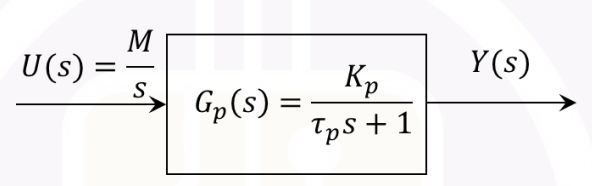
In the open-loop process shown in the figure, the input $U(s)$, the transfer function $G_p(s)$ and the output $Y(s)$ are given in the Laplace domain in terms of the Laplace variable $s$. For this process, which of the following is true?
(where $M, \tau_p, K_p$, are the magnitude of the input, the characteristic time and the gain for the process, respectively) $