A thermometer measuring body temperature follows a first-order response with a time constant of 40 seconds. The instrument will reach 95% of its steady-state output at __________ seconds. (Round off to the nearest integer)
First-Order System Response Calculation
This problem involves calculating the time required for a first-order system, specifically a thermometer, to reach a certain percentage (95%) of its final steady-state output. The response of a first-order system is governed by its time constant, denoted by $\tau$.
Understanding First-Order Response
The output $y(t)$ of a first-order system at time $t$ responding to a step input is given by the formula:
$y(t) = y_{final} \times (1 - e^{-t/\tau})$
Where:
- $y(t)$ is the output at time $t$.
- $y_{final}$ is the final steady-state output.
- $t$ is the time in seconds.
- $\tau$ is the time constant (given as 40 seconds).
Calculating Time for 95% Steady-State Output
We need to find the time $t$ when the thermometer reaches 95% of its steady-state output. This means $y(t) = 0.95 \times y_{final}$.
- Set up the equation: Substitute the desired output percentage into the first-order response formula. $0.95 \times y_{final} = y_{final} \times (1 - e^{-t/\tau})$
- Simplify the equation: Divide both sides by $y_{final}$. $0.95 = 1 - e^{-t/\tau}$
- Isolate the exponential term: Rearrange the equation to solve for the exponential part. $e^{-t/\tau} = 1 - 0.95$ $e^{-t/\tau} = 0.05$
- Solve for t using logarithms: Take the natural logarithm ($\ln$) of both sides. $\ln(e^{-t/\tau}) = \ln(0.05)$ $-t/\tau = \ln(0.05)$
- Substitute the time constant ($\tau$): Plug in the given value of $\tau = 40$ seconds. $-t/40 = \ln(0.05)$
- Calculate the final time: Solve for $t$. $t = -40 \times \ln(0.05)$ Using a calculator, $\ln(0.05) \approx -2.9957$. $t \approx -40 \times (-2.9957)$ $t \approx 119.83 \text{ seconds}$
- Round to the nearest integer: The question asks to round to the nearest integer. $t \approx 120 \text{ seconds}$
Conclusion
The thermometer will reach 95% of its steady-state output in approximately 120 seconds.
Important Questions from First and Second Order Systems
- The transfer function of a process is $G(s) = \frac{K_p}{ \tau_p s+1}$, where $K_p$ is the gain and $ \tau_p$ is the time constant. This is a __________ process.
The output $y(t)$ of a first-order process is governed by the following differential equation
$\tau_p\frac{dy}{ dt} + y = K_p f(t)$
where $T_p$ is a non-zero time constant, $K_p$ is the gain and $f(t)$ is the input with $f(0) = 0$.
Assume $y(0) = 0$. The transfer function for this process is (consider $s$ as the independent variable in the Laplace domain)
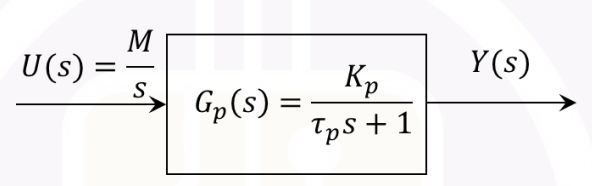
In the open-loop process shown in the figure, the input $U(s)$, the transfer function $G_p(s)$ and the output $Y(s)$ are given in the Laplace domain in terms of the Laplace variable $s$. For this process, which of the following is true?
(where $M, \tau_p, K_p$, are the magnitude of the input, the characteristic time and the gain for the process, respectively) $