The output $y(t)$ of a first-order process is governed by the following differential equation $\tau_p\frac{dy}{ dt} + y = K_p f(t)$ where $T_p$ is a non-zero time constant, $K_p$ is the gain and $f(t)$ is the input with $f(0) = 0$. Assume $y(0) = 0$. The transfer function for this process is (consider $s$ as the independent variable in the Laplace domain)
$\frac{K_p}{\tau_p s + 1}$
Process Dynamics: Transfer Function Derivation
The problem asks for the transfer function of a first-order process described by the differential equation: $ \tau_p\frac{dy}{ dt} + y = K_p f(t) $ with initial conditions $y(0) = 0$ and $f(0) = 0$. The transfer function relates the output $Y(s)$ to the input $F(s)$ in the Laplace domain.
Laplace Transform Application
To find the transfer function, we take the Laplace transform of the differential equation. We use the following standard Laplace transform properties:
- $ \mathcal{L}\left\{\frac{dx(t)}{dt}\right\} = sX(s) - x(0) $
- $ \mathcal{L}\{x(t)\} = X(s) $
Applying the Laplace transform to the given equation:
$ \mathcal{L}\left\{\tau_p\frac{dy}{ dt} + y\right\} = \mathcal{L}\{K_p f(t)\} $
$ \tau_p \mathcal{L}\left\{\frac{dy}{ dt}\right\} + \mathcal{L}\{y\} = K_p \mathcal{L}\{f(t)\} $
Applying Initial Conditions
Substitute the Laplace transforms and the initial conditions ($y(0) = 0$, $f(0) = 0$):
$ \tau_p (sY(s) - y(0)) + Y(s) = K_p F(s) $
$ \tau_p (sY(s) - 0) + Y(s) = K_p F(s) $
$ \tau_p s Y(s) + Y(s) = K_p F(s) $
Calculating the Transfer Function
Factor out $Y(s)$ from the left side:
$ Y(s)(\tau_p s + 1) = K_p F(s) $
The transfer function $G(s)$ is the ratio of the output transform $Y(s)$ to the input transform $F(s)$:
$ G(s) = \frac{Y(s)}{F(s)} $
Rearranging the equation to solve for $G(s)$:
$ G(s) = \frac{K_p}{\tau_p s + 1} $
Final Answer
This result matches option 1. The transfer function for the given first-order process is $ \frac{K_p}{\tau_p s + 1} $.
Important Questions from First and Second Order Systems
- The transfer function of a process is $G(s) = \frac{K_p}{ \tau_p s+1}$, where $K_p$ is the gain and $ \tau_p$ is the time constant. This is a __________ process.
A thermometer measuring body temperature follows a first-order response with a time constant of 40 seconds. The instrument will reach 95% of its steady-state output at __________ seconds.
(Round off to the nearest integer)
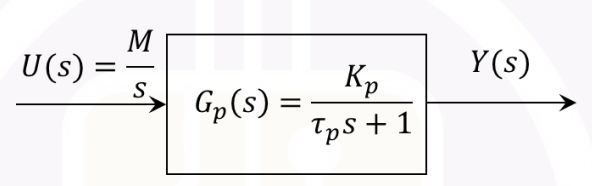
In the open-loop process shown in the figure, the input $U(s)$, the transfer function $G_p(s)$ and the output $Y(s)$ are given in the Laplace domain in terms of the Laplace variable $s$. For this process, which of the following is true?
(where $M, \tau_p, K_p$, are the magnitude of the input, the characteristic time and the gain for the process, respectively) $