The specific rotation of enantiomerically pure (S)-2-butanol is $+14^\circ$. The specific rotation of enantiomeric mixture of 2-butanol obtained from an asymmetric reduction of 2-butanone is found to be $+7^\circ$. The percentage of (R)-2-butanol present in the reaction mixture is ________ (in integer).
Understanding Chirality and Specific Rotation
This question involves calculating the composition of an enantiomeric mixture using specific rotation data. Key concepts are specific rotation and enantiomeric excess (ee).
Calculating Enantiomeric Excess (ee)
The enantiomeric excess (ee) measures the difference between the amounts of the two enantiomers in a mixture. It can be calculated using the specific rotations:
- Specific rotation of pure (S)-2-butanol: $[α]_{pure} = +14^\circ$
- Specific rotation of the mixture: $[α]_{mixture} = +7^\circ$
The formula for ee based on specific rotation is:
$ ee = \frac{[α]_{mixture}}{[α]_{pure}} \times 100\% $Substituting the given values:
$ ee = \frac{+7^\circ}{+14^\circ} \times 100\% = 0.5 \times 100\% = 50\% $Since the mixture's rotation ($+7^\circ$) is positive, the (S)-enantiomer (with rotation $+14^\circ$) is the major component.
Determining Percentage of (R)-2-butanol
An ee of 50% means the major enantiomer is in excess by 50% over the minor enantiomer. Let $X_S$ be the percentage of (S)-2-butanol and $X_R$ be the percentage of (R)-2-butanol.
- We know $X_S + X_R = 100\%$ (Total percentage).
- We also know $ee = X_S - X_R = 50\%$ (Excess of the major, S, enantiomer).
Solving these two equations:
- Add the two equations: $(X_S + X_R) + (X_S - X_R) = 100\% + 50\%$
- This simplifies to $2X_S = 150\%$, so $X_S = 75\%$.
- Substitute $X_S$ back into the first equation: $75\% + X_R = 100\%$.
- Therefore, $X_R = 100\% - 75\% = 25\%$.
The percentage of (R)-2-butanol in the mixture is 25%.
Important Questions from Stereochemistry
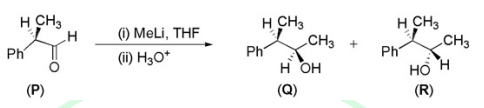
In the following reaction, 13.4 grams of aldehyde P gave a diastereomeric mixture of alcohols Q and R in a ratio of 2:1. If the yield of the reaction is 80%, then the amount of Q (in grams) obtained is ________ (in integer).
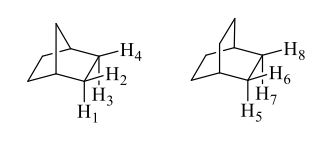
The correct statement(s) about the relationship for the H-atoms in the following compounds is (are):
The number of possible stereoisomers for cyclononene is ______________
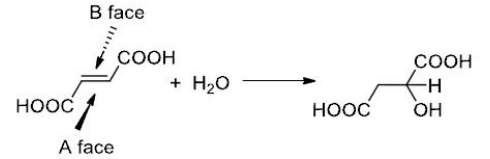
Hydration of fumaric acid gives malic acid as shown below. Assume that addition of water takes place specifically from A face or B face. The correct statement pertaining to stereochemistry of malic acid formed is
The number of possible stereoisomers obtained in the following reaction is _____________