The correct statement(s) about the relationship for the H-atoms in the following compounds is (are):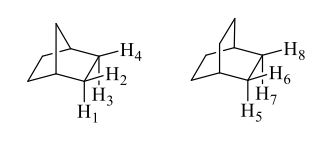
To solve this problem, we need to determine the relationship between the hydrogen atoms in the given compounds. Let's analyze each pair of hydrogens to identify if they are enantiotopic, diastereotopic, or homotopic.
Definitions:
- Enantiotopic: When the replacement of one hydrogen at a time by another group generates molecules that are non-superimposable mirror images (enantiomers).
- Diastereotopic: When the replacement of one hydrogen at a time by another group generates molecules that are not mirror images (diastereomers).
- Homotopic: When the replacement of one hydrogen at a time results in the same compound.
Analysis:
- Consider $H_1$ and $H_3$:
- If we replace $H_1$ and $H_3$ one at a time, we form enantiomers because the molecule will have a chiral center after replacement.
- Therefore, $H_1$ and $H_3$ are \(enantiotopic\).
- Consider $H_2$ and $H_3$:
- Replacing $H_2$ and $H_3$ one at a time will result in diastereomers due to the presence of additional stereogenic centers.
- Hence, $H_2$ and $H_3$ are \(diastereotopic\).
- Consider $H_5$ and $H_7$:
- Replacing $H_5$ and $H_7$ one at a time results in enantiomers.
- Thus, $H_5$ and $H_7$ are \(enantiotopic\).
- Consider $H_6$ and $H_7$:
- Replacing $H_6$ and $H_7$ does not change the molecule at all, resulting in identical structures.
- Therefore, $H_6$ and $H_7$ are \(homotopic\).
Conclusion:
The correct statements are:
- $H_1$ and $H_3$ are enantiotopic; $H_2$ and $H_3$ are diastereotopic.
- $H_5$ and $H_7$ are enantiotopic; $H_6$ and $H_7$ are homotopic.
Important Questions from Stereochemistry
The reaction(s) that give(s) meso-1,2-diphenylethane-1,2-diol as the major product is(are)
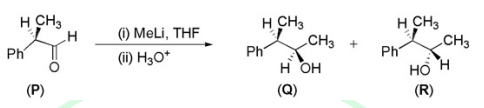
In the following reaction, 13.4 grams of aldehyde P gave a diastereomeric mixture of alcohols Q and R in a ratio of 2:1. If the yield of the reaction is 80%, then the amount of Q (in grams) obtained is ________ (in integer).
- The enantiomeric pair, among the following, is
The favourable transition state leading to the formation of the product in the following reaction, is
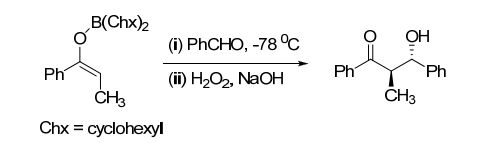
The number of possible stereoisomers obtained in the following reaction is _____________