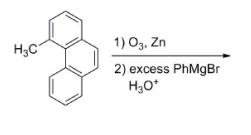
The favourable transition state leading to the formation of the product in the following reaction, is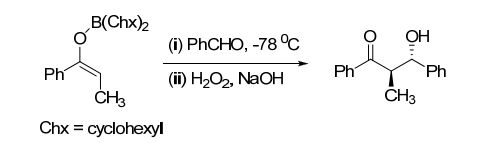
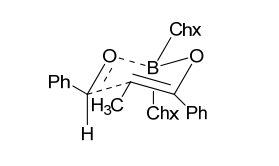
The reaction given involves the use of a boronic ester for an aldol-like reaction with a subsequent oxidation step which indicates the mechanism likely follows a boronate transition state. The mechanism can be explained as follows:
- The reaction begins with the formation of a complex between the boron and the aldehyde, facilitating the transfer of the nucleophilicity to the carbonyl carbon.
- The intermediate complex rearranges to facilitate the formation of the new carbon-carbon bond.
- This leads to the formation of a boronate ester transition state, which stabilizes the negative charge through a six-membered ring.
- The oxidation step with hydrogen peroxide converts the boronate intermediate to the alcohol.
In terms of stability and favorability, the six-membered ring transition state is preferred due to minimal steric hindrance and optimal orbital overlap.
After examining the provided options, the correct transition state corresponds to a cyclic six-membered intermediate complex which facilitates the carbon-carbon bond formation.
The correct structure above is favored due to its stability and the position of substituents that reduce steric crowding and allow for effective nucleophilic attack.
Important Questions from Stereochemistry
The reaction(s) that give(s) meso-1,2-diphenylethane-1,2-diol as the major product is(are)
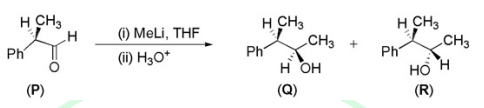
In the following reaction, 13.4 grams of aldehyde P gave a diastereomeric mixture of alcohols Q and R in a ratio of 2:1. If the yield of the reaction is 80%, then the amount of Q (in grams) obtained is ________ (in integer).
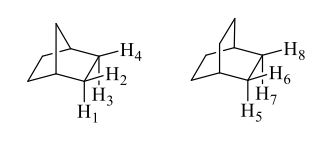
The correct statement(s) about the relationship for the H-atoms in the following compounds is (are):
- The enantiomeric pair, among the following, is
The number of possible stereoisomers obtained in the following reaction is _____________