
(en = ethylenediamine)
Understanding the 18-Electron Rule
The 18-electron rule is a guideline used in coordination chemistry to predict the stability of organometallic complexes. It suggests that stable transition metal complexes often contain 18 valence electrons, similar to the electron configuration of noble gases.
The total valence electron count is calculated by summing:
- The number of valence electrons contributed by the metal atom (based on its group number).
- The number of electrons donated by the ligands (considering neutral or anionic ligands and their bonding modes).
- Adjustments for the overall charge of the complex.
Analyzing Complex Electron Counts
We calculate the total valence electrons for each option:
-
Option 1: $[Rh(PPh_3)_3Cl]$
- Metal: Rhodium (Rh) is in Group 9, contributing 9 valence electrons.
- Ligands: 3 Triphenylphosphine ($PPh_3$) ligands (2 electrons each) = $3 \times 2 = 6$ electrons. 1 Chloride (Cl) ligand (treated as neutral) = 1 electron.
- Total Electrons: $9 + 6 + 1 = 16$ electrons.
-
Option 2: $[Co(NH_3)_6]^{2+}$
- Metal: Cobalt (Co) is in Group 9, contributing 9 valence electrons.
- Ligands: 6 Ammonia ($NH_3$) ligands (2 electrons each) = $6 \times 2 = 12$ electrons.
- Charge: The +2 charge means we subtract 2 electrons.
- Total Electrons: $9 + 12 - 2 = 19$ electrons.
-
Option 3: $[V(CO)_6]^-$
- Metal: Vanadium (V) is in Group 5, contributing 5 valence electrons.
- Ligands: 6 Carbonyl (CO) ligands (2 electrons each) = $6 \times 2 = 12$ electrons.
- Charge: The -1 charge means we add 1 electron.
- Total Electrons: $5 + 12 + 1 = 18$ electrons.
-
Option 4: $[Ni(en)_3]^{2+}$
- Metal: Nickel (Ni) is in Group 10, contributing 10 valence electrons.
- Ligands: 3 Ethylenediamine ($en$) ligands (bidentate, 4 electrons each) = $3 \times 4 = 12$ electrons.
- Charge: The +2 charge means we subtract 2 electrons.
- Total Electrons: $10 + 12 - 2 = 20$ electrons.
Conclusion on 18-Electron Rule Compliance
Based on the calculations:
- $[Rh(PPh_3)_3Cl]$ has 16 electrons.
- $[Co(NH_3)_6]^{2+}$ has 19 electrons.
- $[V(CO)_6]^-$ has 18 electrons.
- $[Ni(en)_3]^{2+}$ has 20 electrons.
Therefore, the species that follows the 18-electron rule is $[V(CO)_6]^-$.
Important Questions from 18 Electron Rule
The number of metal-metal bond(s) in the complex $[(\eta^5-Cp)Mo(CO)_2]_2$ is $x$ and in $[(\eta^5-Cp)_2Fe_2(CO)_3]$ is $y$. The value of $x + y$ is ___________.
(Assume 18 electron rule is followed.)
(Answer in integer)The total number of valence electrons in $W(\eta^3-Cp)(\eta^5-Cp)(CO)_2$ is ______________.(Atomic number of W = 74)
$[CpMoCl_2]_2$ obeys the 18 electron rule. The correct structure of this compound is
(atomic number of Mo = 42)
The given zirconocene compound, $(\eta^5-\text{Cp})_2\text{ZrEt}_2$, when heated in the presence of an equimolar amount of $\text{PMe}_3$ results in the formation of a compound $X$ which obeys the 18 electron rule. The reaction also resulted in the release of a saturated hydrocarbon.
[Given: Atomic number of $\text{Zr} = 40$]
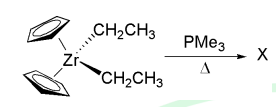
The structure of compound $X$ is ________


