
The number of metal-metal bond(s) in the complex $[(\eta^5-Cp)Mo(CO)_2]_2$ is $x$ and in $[(\eta^5-Cp)_2Fe_2(CO)_3]$ is $y$. The value of $x + y$ is ___________.
(Assume 18 electron rule is followed.)
(Answer in integer)
The problem asks us to find the value of $x + y$, where $x$ is the number of metal-metal bonds in $[(\eta^5-Cp)Mo(CO)_2]_2$ and $y$ is the number of metal-metal bonds in $[(\eta^5-Cp)_2Fe_2(CO)_3]$. We assume the 18-electron rule is followed for both complexes.
Metal Bonds in $[(\eta^5-Cp)Mo(CO)_2]_2$ (x)
We determine the number of metal-metal bonds ($x$) by applying the 18-electron rule to each Molybdenum (Mo) atom.
- Molybdenum (Mo) is in Group 6, contributing 6 valence electrons ($VE_{Mo} = 6$).
- The $\eta^5$-Cyclopentadienyl (Cp) ligand contributes 5 electrons ($Cp = 5 e^-$).
- Each Carbonyl (CO) ligand contributes 2 electrons ($CO = 2 e^-$).
- In the complex $[(\eta^5-Cp)Mo(CO)_2]_2$, each Mo is associated with one Cp and two CO ligands.
- Total electrons from ligands around one Mo: $5 (Cp) + 2 \times 2 (CO) = 9 e^-$.
- To follow the 18-electron rule, the electrons contributed by the Mo-Mo bond(s) to each Mo atom must be: $18 e^- - VE_{Mo} - e^-_{ligands} = 18 - 6 - 9 = 3 e^-$.
- A contribution of 3 electrons typically corresponds to a triple metal-metal bond. Therefore, we conclude $x=3$.
Metal Bonds in $[(\eta^5-Cp)_2Fe_2(CO)_3]$ (y)
We determine the number of metal-metal bonds ($y$) by applying the 18-electron rule to each Iron (Fe) atom. This complex structure typically involves one bridging CO ligand.
- Iron (Fe) is in Group 8, contributing 8 valence electrons ($VE_{Fe} = 8$).
- The $\eta^5$-Cp ligand contributes 5 electrons ($Cp = 5 e^-$).
- Assume one CO ligand is bridging ($CO_{bridge} = 1 e^-$ per Fe) and the remaining two are terminal ($CO_{term} = 2 e^-$).
- Total electrons from ligands around one Fe: $5 (Cp) + 2 (CO_{term}) + 1 (CO_{bridge}) = 8 e^-$.
- To follow the 18-electron rule, the electrons contributed by the Fe-Fe bond(s) to each Fe atom must be: $18 e^- - VE_{Fe} - e^-_{ligands} = 18 - 8 - 8 = 2 e^-$.
- A contribution of 2 electrons typically corresponds to a double metal-metal bond. Therefore, we conclude $y=2$.
Calculate Total Metal Bonds (x + y)
The total number of metal-metal bonds is the sum of $x$ and $y$.
- $x = 3$ (Mo-Mo bonds)
- $y = 2$ (Fe-Fe bonds)
- $x + y = 3 + 2 = 5$.
The value of $x + y$ is 5.
Important Questions from 18 Electron Rule
The total number of valence electrons in $W(\eta^3-Cp)(\eta^5-Cp)(CO)_2$ is ______________.(Atomic number of W = 74)
$[CpMoCl_2]_2$ obeys the 18 electron rule. The correct structure of this compound is
(atomic number of Mo = 42)
The given zirconocene compound, $(\eta^5-\text{Cp})_2\text{ZrEt}_2$, when heated in the presence of an equimolar amount of $\text{PMe}_3$ results in the formation of a compound $X$ which obeys the 18 electron rule. The reaction also resulted in the release of a saturated hydrocarbon.
[Given: Atomic number of $\text{Zr} = 40$]
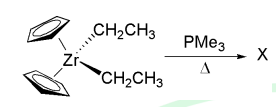
The structure of compound $X$ is ________
- The species which follows 18-electron rule is
(en = ethylenediamine)


