
The sequence of states ($Q_1Q_0$) of the given synchronous sequential circuit is ____________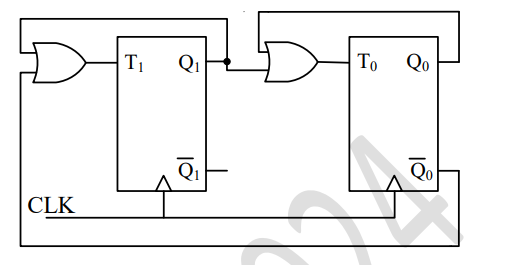
$11 \to 00 \to 10 \to 01 \to 00$
To find the sequence of states for the given synchronous sequential circuit, we need to analyze the logic connections and determine the next state for each possible current state.
1. Identify the Excitation Equations
The circuit consists of two T flip-flops, \(FF_1\) (most significant bit) and \(FF_0\) (least significant bit). By tracing the connections from the outputs to the inputs of the OR gates, we get the excitation equations:
- For flip-flop 1: \(T_1 = Q_1 + \overline{Q}_0\)
- For flip-flop 0: \(T_0 = Q_1 + Q_0\)
2. Next State Equations
The characteristic equation for a T flip-flop is \(Q_{next} = T \oplus Q_{current}\). Substituting the excitation equations, we derive the next state logic:
- \(Q_1^+ = T_1 \oplus Q_1 = (Q_1 + \overline{Q}_0) \oplus Q_1\)
- \(Q_0^+ = T_0 \oplus Q_0 = (Q_1 + Q_0) \oplus Q_0\)
Using Boolean simplification properties:
- If \(Q_1 = 0\), \(Q_1^+ = \overline{Q}_0\). If \(Q_1 = 1\), \(Q_1^+ = 1 \oplus 1 = 0\). Thus, \(Q_1^+ = \overline{Q}_1 \cdot \overline{Q}_0\).
- If \(Q_0 = 1\), \(Q_0^+ = 1 \oplus 1 = 0\). If \(Q_0 = 0\), \(Q_0^+ = Q_1 \oplus 0 = Q_1\). Thus, \(Q_0^+ = Q_1 \cdot \overline{Q}_0\).
3. State Transition Table
Now, we calculate the next state \((Q_1 Q_0)^+\) for all possible present states \((Q_1 Q_0)\):
| Present State \((Q_1 Q_0)\) | \(T_1 = Q_1 \lor \overline{Q}_0\) | \(T_0 = Q_1 \lor Q_0\) | \(Q_1^+ = T_1 \oplus Q_1\) | \(Q_0^+ = T_0 \oplus Q_0\) | Next State \((Q_1 Q_0)^+\) |
|---|---|---|---|---|---|
| \(00\) | \(0 \lor 1 = 1\) | \(0 \lor 0 = 0\) | \(1 \oplus 0 = 1\) | \(0 \oplus 0 = 0\) | \(10\) |
| \(10\) | \(1 \lor 1 = 1\) | \(1 \lor 0 = 1\) | \(1 \oplus 1 = 0\) | \(1 \oplus 0 = 1\) | \(01\) |
| \(01\) | \(0 \lor 0 = 0\) | \(0 \lor 1 = 1\) | \(0 \oplus 0 = 0\) | \(1 \oplus 1 = 0\) | \(00\) |
| \(11\) | \(1 \lor 0 = 1\) | \(1 \lor 1 = 1\) | \(1 \oplus 1 = 0\) | \(1 \oplus 1 = 0\) | \(00\) |
4. Sequence Analysis
Based on the table, the state transitions are:
- \(00 \rightarrow 10\)
- \(10 \rightarrow 01\)
- \(01 \rightarrow 00\)
- \(11 \rightarrow 00\)
Tracing these transitions starting from state \(11\), we get: $$11 \rightarrow 00 \rightarrow 10 \rightarrow 01 \rightarrow 00 \dots$$
Conclusion
The sequence matches the second option provided in the problem statement.
Correct Sequence: \(11 \rightarrow 00 \rightarrow 10 \rightarrow 01 \rightarrow 00\)
Important Questions from Sequential Circuits
The design of synchronous circuit involves following steps
A. From the specifications, derive a state diagram of a circuit
B. Derive the simplified flip-flops input and output equations.
C. Reduce the number of state, if necessary
D. Choose the type of flip-flops to be used
E. Assign binary values to the states and obtain binary coded table
Choose the correct answer from the options given below:
- Find the time periods ($T_{ON}$ and $T_{OFF}$) of an astable multivibrators that oscillates at 50 kHz and 60% duty cycle.
In the procedural statement, reset action occurs if ____________
always @ (negedge clock) begin
if (! Reset) D=0; else Q=D
end
Read the following statements :
i. Gate is a combinational logic.
ii. JK Flip-flop in toggle mode is not combinational logic.
iii. MSJK FF suffers from race-around.
iv. Counters are sequential circuits.Which is correct ?
Which flip-flop can be used as latch ?


