
The relative performance of amphibians adapted to tropical (dashed line) and temperate (solid line) climates as a function of temperature is shown below. Assume that global warming will result in an equal increase in mean temperatures over the next 30 years in both regions. Which of the following statements about the effects of global warming on these two amphibians is most likely?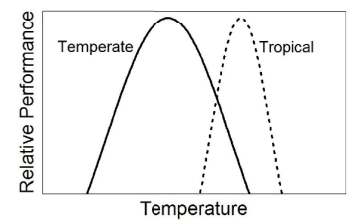
The question involves understanding how amphibians adapted to different climates might be impacted by global warming. Let's analyze the given information step by step:
From the graph, we observe that the relative performance of tropical amphibians (dashed line) peaks at a higher temperature compared to temperate amphibians (solid line). This indicates that tropical amphibians are adapted to warmer climates.
Both amphibians will experience an equal increase in temperature due to global warming. Since tropical amphibians are already accustomed to higher temperatures, an increase in temperature could push them towards or beyond their optimal performance range.
Temperate amphibians, on the other hand, are adapted to cooler climates. Although they will be impacted by the rise in temperature, their performance range is likely not yet at the extreme. Therefore, they might not be as negatively impacted as tropical amphibians.
Therefore, the most likely effect of global warming would be that tropical amphibians will be more negatively impacted than temperate amphibians, as they are pushed beyond their optimal temperature range.
Thus, the correct answer is: Tropical amphibians will be more negatively impacted than temperate amphibians.
Important Questions from Abiotic factors
- Species that co-occur in space and time tend to be similar to each other in traits such as tolerance to heat or to drought. This is most likely because of _________.
- A researcher carried out an experiment to study how daylength and temperature influence diapause in a moth species. He placed larvae in one of four treatment conditions for 2 weeks, with 30 larvae in each condition. The treatments involved two temperatures ($18\text{ }^\circ\text{C}$ or $27\text{ }^\circ\text{C}$) and two lighting conditions (12h:12h Light:Dark (LD) or complete darkness (DD)). At the end of the experiment, he counted the number of larvae that had entered diapause and those that had not. The data are shown below.Which one or more of the following conclusions can he reasonably make from these findings?
Condition Larvae in diapause Larvae NOT in diapause Treatment 1 $27\text{ }^\circ\text{C}$, 12:12 LD 2 28 Treatment 2 $18\text{ }^\circ\text{C}$, 12:12 LD 7 23 Treatment 3 $27\text{ }^\circ\text{C}$, DD 12 18 Treatment 4 $18\text{ }^\circ\text{C}$, DD 29 1 - Terrestrial plants conduct gas exchange through stomata. Having only few stomata on the leaf surface is a common adaptation to which one of the following conditions?
- Some air-breathing marine vertebrates such as whales, seals and marine turtles possess adaptations for long, deep dives. Which one or more of the following is/are examples of such adaptations?
- Which one or more of the following is/are greenhouse gas(es)?


