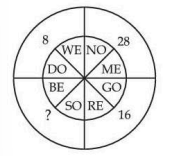
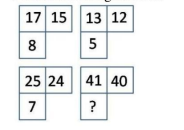
The relationship among the numbers in each corner square is the same as that in the other corner squares. Find the missing number.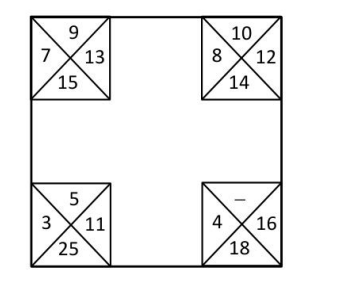
To solve this problem, we need to find the missing number in the lower-right corner using the pattern seen in the other squares.
Let's evaluate the given pattern in each corner:
- Top-left corner: The numbers are 9, 7, 13, and 15.
The pattern appears as follows: \((9 + 7 - 13) = 3\), then \(3 \times 5 = 15\).
- Top-right corner: The numbers are 10, 8, 12, and 14.
Similarly, the pattern is: \((10 + 8 - 12) = 6\), then \(6 \times 2 = 14\).
- Bottom-left corner: The numbers are 5, 3, 11, and 25.
For this pattern: \((5 + 3 - 11) = -3\), then \(-3 \times (-5) = 15\).
We see that the pattern follows \({a + b - c = x}\) and this result \(x\) multiplied by a factor results in the fourth number.
Now, applying this to the bottom-right corner:
- The numbers are 4, 6 (missing number), 16, and 18.
Applying the pattern: \((4 + x - 16) \times n = 18\).
Let's find the solution by setting \(n\) consistent through other corners:
- Calculating for \(x\):
Solve \((4 + x - 16) \times 1 = 18\), we get: \({4 + x - 16 = 18}\), implying \(x = 6\).
Therefore, the missing number is 6.
Hence, the correct answer is 6.
Important Questions from Missing Number (Notes)
- If,
5$3@1 = 7
6$2@2 = 6
Then, 1$2@3=? Find the missing number in the following figure.
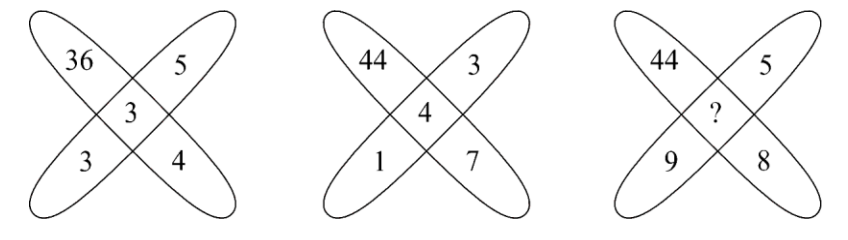
Which one will replace the question mark (?) ?
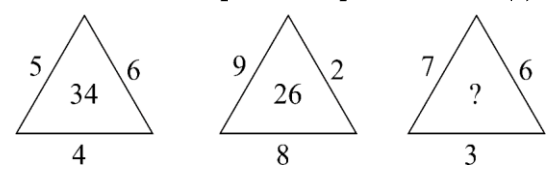
Find the missing number.
What number will come in place of question mark to complete the pattern ?