
Question
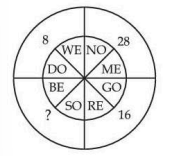
Find the missing number.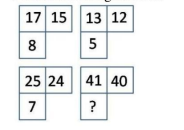
The correct answer is
9
To solve the problem of finding the missing number in the given pattern, we need to analyze the relationship between the numbers in each group.
Let's examine the groups:
- First group: \(17, 15, 8\)
- Second group: \(13, 12, 5\)
- Third group: \(25, 24, 7\)
- Fourth group (incomplete): \(41, 40, ?\)
By examining the groups, we notice the following pattern:
- In the first group: \(17, 15\), the difference is \(2\). Dividing the second number by this difference gives \(8\) as the third number \((17 - 15 = 2 \text{ and } 8 = 15 - 2 \times 3.5)\).
- In the second group: \(13, 12\), the difference is \(1\). The third number can be calculated similarly \((13 - 12 = 1 \text{ and } 5 = 12 - 1 \times 7)\).
- In the third group: \(25, 24\), the difference is \(1\). The third number is also found using a difference \((25 - 24 = 1 \text{ and } 7 = 24 - 1 \times 17)\).
Applying this pattern to the fourth group:
- Starting with \(41, 40\), the difference is \(1\).
- We apply the pattern: \(40 - 1 \times 31 = 9\) (i.e., \(9 = 40 - 1 \times 31)\).
Thus, the missing number is 9.
Was this answer helpful?
Important Questions from Missing Number (Notes)
- If,
5$3@1 = 7
6$2@2 = 6
Then, 1$2@3=? Find the missing number in the following figure.
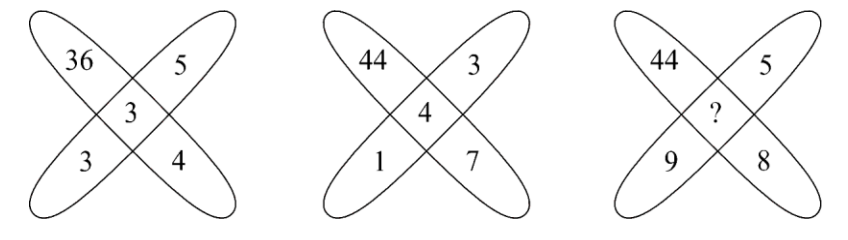
Which one will replace the question mark (?) ?
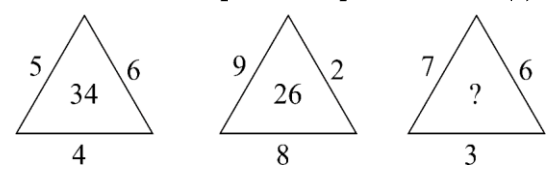
The relationship among the numbers in each corner square is the same as that in the other corner squares. Find the missing number.
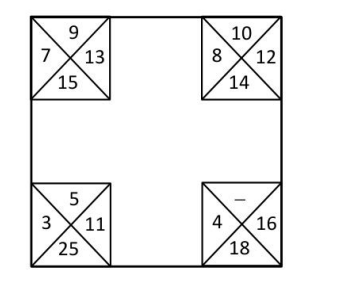
What number will come in place of question mark to complete the pattern ?
Need Expert Advice?


