5$3@1 = 7
6$2@2 = 6
Then, 1$2@3=?
Solving the Number Pattern Puzzle
This question tests your ability to identify a pattern in a sequence of numbers involving specific symbols ('$' and '@'). We need to figure out the rule connecting the numbers on the left side of the equation to the result on the right side.
Analyzing the Given Examples
Let's examine the two examples provided to deduce the underlying mathematical rule:
- Example 1: $5$3@1 = 7$
- Example 2: $6$2@2 = 6$
Identifying the Pattern
We can represent the pattern as $A$B@C = Result$. Let's test a simple arithmetic relationship:
Consider the operation: $(First Number + Second Number) - Third Number$
Let's apply this to Example 1:
$(5 + 3) - 1$
$8 - 1 = 7$
This matches the result given in Example 1.
Now, let's apply the same rule to Example 2:
$(6 + 2) - 2$
$8 - 2 = 6$
This also matches the result given in Example 2.
Therefore, the pattern is confirmed: $(A + B) - C = Result$.
Applying the Pattern to Find the Solution
Now we apply the identified pattern to the question: $1$2@3 = ?$
Here, A=1, B=2, and C=3.
Using the formula $(A + B) - C$:
$(1 + 2) - 3$
$3 - 3 = 0$
Final Result
The calculation shows that $1$2@3$ equals 0.
The correct option is the one that represents the value 0.
Important Questions from Missing Number (Notes)
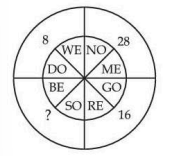
Find the missing number in the following figure.
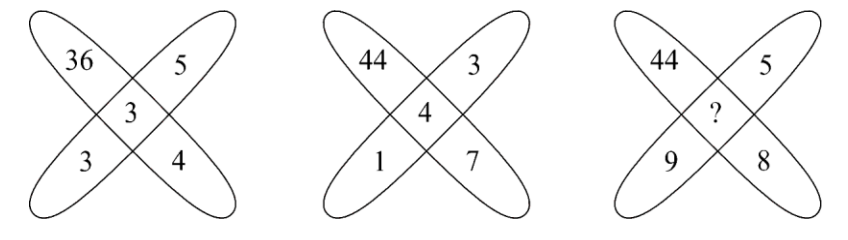
Which one will replace the question mark (?) ?
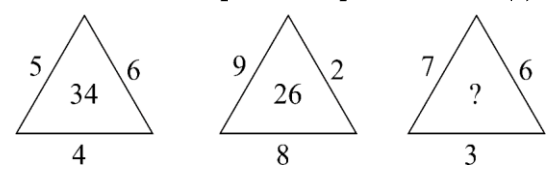
The relationship among the numbers in each corner square is the same as that in the other corner squares. Find the missing number.
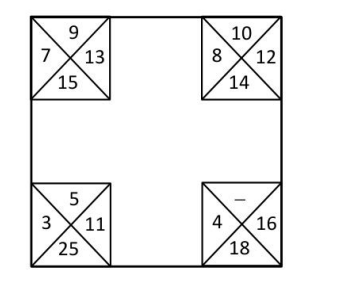
Find the missing number.
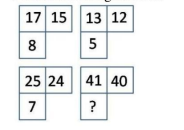
What number will come in place of question mark to complete the pattern ?