
The reactants P and Q in the following reaction are 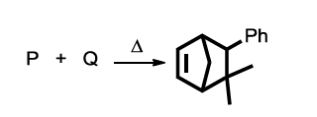
To determine the reactants P and Q in the given reaction, we need to analyze the reaction pathway leading to the provided product image, which appears to be a cyclized compound with a phenyl group (Ph). This is suggestive of an alkene undergoing a Diels-Alder reaction or a related cyclization. The key to solving this question is recognizing the type of reaction depicted in the image and determining the precursor structures that would lead to the formation of this product.
- Identify the Reaction Type: The product structure indicates a possible Diels-Alder type reaction that involves a diene and a dienophile. Given the presence of a three-membered ring, it is likely produced from a bicyclic intermediate, which is common in such reactions.
- Analyze Product Structure: The structure implies a cycloaddition reaction where the presence of a bridge signifies that the reactants could be structured to allow this type of cyclization.
- Assess Reactant Possibilities: With cycloadditions where a diene combines with an alkenyl group, evaluate each option in terms of the presence of potential diene or alkene functionalities that could generate the bridged compound.
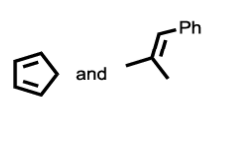
After evaluation and comparison with the correct answer, the reactants P and Q should be a conjugated diene and an alkene capable of forming the observed bridged ring. The correct combination is:
This selection of reactants corresponds to the required chemical motifs that combine through a Diels-Alder reaction to form the observed product.
Conclusion
By identifying the reaction type as a cycloaddition and recognizing the necessary reactive fragments (diene and dienophile), we can conclude that the given pair of reactants would lead to the formation of the presented chemical structure through a thermal cyclization pathway.
Tips for Solving Similar Questions:
- Always check for congruency between the product structure and possible reaction mechanisms.
- Familiarize yourself with common reaction types involved in the synthesis of various molecular frameworks.
- Understand typical functional group transformations and their resulting products for accurate prediction.
Important Questions from Organic Structure Stability
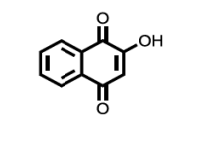
The total number of tautomers for the following molecule (including the structure provided below) is ____________
- The Diels-Alder adduct from the reaction between cyclopentadiene and benzyne is
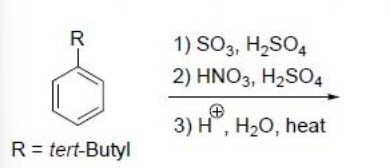
The major product from the following reaction is
The order of resonance energy for the following molecules is
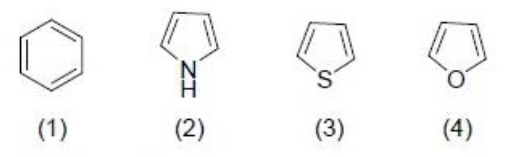
The compound, which upon mono-nitration using a mixture of HNO$_3$ and H$_2$SO$_4$, does NOT give the meta-isomer as the major product, is


