
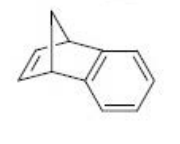
Diels-Alder Reaction: Cyclopentadiene and Benzyne Adduct
The Diels-Alder reaction is a fundamental [4+2] cycloaddition reaction in organic chemistry. It involves the reaction between a conjugated diene (containing 4 pi electrons) and a dienophile (containing 2 pi electrons) to form a six-membered ring.
Identifying Reactants
- Diene: Cyclopentadiene. This cyclic molecule readily acts as the diene component.
- Dienophile: Benzyne. This is a highly reactive intermediate featuring a triple bond within a benzene ring, acting as the dienophile.
Predicting the Adduct Structure
The reaction between cyclopentadiene and benzyne forms a bicyclic adduct. The cyclopentadiene molecule adds across the triple bond of benzyne. The resulting structure is a bicyclo[2.2.2]octadiene skeleton fused with the aromatic ring derived from benzyne. Specifically, the two carbons forming the triple bond in benzyne become the bridgehead carbons of the bicyclo[2.2.2] system. The carbons from cyclopentadiene form the bridges, including one double bond bridge and one methylene bridge ($-\text{CH}_2-$).
Analyzing the Options
We need to identify the structure that represents this bicyclo[2.2.2]octadiene fused system:
- Option 1 does not show the correct fused ring structure.
- Options 2 and 3 depict bridged bicyclic structures fused to a benzene ring, but the bridging components do not accurately represent the adduct formed from cyclopentadiene and benzyne.
- Option 4 correctly shows the Diels-Alder adduct. It features a benzene ring fused to a bicyclo[2.2.2]octene core, consistent with the cycloaddition of cyclopentadiene and benzyne.
Therefore, the Diels-Alder adduct from the reaction between cyclopentadiene and benzyne is represented by the structure in Option 4.
Important Questions from Organic Structure Stability
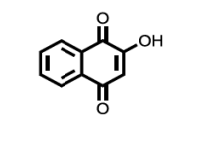
The total number of tautomers for the following molecule (including the structure provided below) is ____________
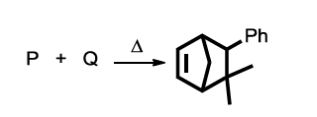
The reactants P and Q in the following reaction are
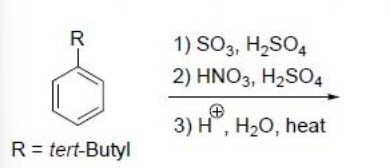
The major product from the following reaction is
The order of resonance energy for the following molecules is
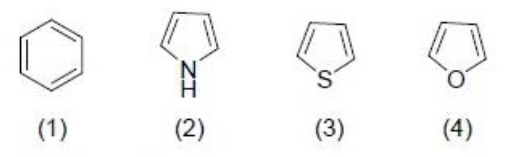
The compound, which upon mono-nitration using a mixture of HNO$_3$ and H$_2$SO$_4$, does NOT give the meta-isomer as the major product, is


