Probability Calculation Steps
We are given the probabilities related to a student passing in Hindi and English:
- Probability of passing only in Hindi: P(H only) = $\frac{1}{4}$
- Probability of passing only in English: P(E only) = $\frac{5}{9}$
- Probability of passing in both Hindi and English: P(H $\cap$ E) = $\frac{1}{9}$
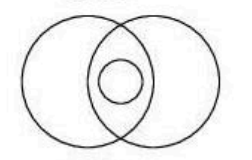
We need to find the probability that the student passes in at least one of these two subjects. This is represented by the union of the two events, P(H $\cup$ E).
The probability of passing in at least one subject can be calculated by summing the probabilities of the mutually exclusive events that make up the union:
P(H $\cup$ E) = P(H only) + P(E only) + P(H $\cap$ E)
Substitute the given values into the formula:
P(H $\cup$ E) = $\frac{1}{4} + \frac{5}{9} + \frac{1}{9}$
First, add the probabilities of passing only in English and passing in both:
$\frac{5}{9} + \frac{1}{9} = \frac{6}{9}$
Simplify the fraction $\frac{6}{9}$:
$\frac{6}{9} = \frac{2}{3}$
Now, add the probability of passing only in Hindi to this result:
P(H $\cup$ E) = $\frac{1}{4} + \frac{2}{3}$
To add these fractions, find a common denominator, which is 12:
- $\frac{1}{4} = \frac{1 \times 3}{4 \times 3} = \frac{3}{12}$
- $\frac{2}{3} = \frac{2 \times 4}{3 \times 4} = \frac{8}{12}$
Add the fractions:
P(H $\cup$ E) = $\frac{3}{12} + \frac{8}{12} = \frac{11}{12}$
Therefore, the probability that the student will pass in at least one of these two subjects is $\frac{11}{12}$.
Similar Questions
- By using Cauchy integral theorem, the value of an integral (integration being taken in counter clock wise direction) $\oint \frac{Z^3-4}{3Z-i} dZ$ is :
- The braking distance for a vehicle moving on a positive 3% grade at an initial speed of $50 \text{ Km/hr}$ and final speed of $20 \text{ Km/hr}$ would be :
- Following are the statements for a square matrix A :
A. If A is invertible then $\text{det(A)} \neq 0$
B. If $\text{det(A)} = 0$, A has no inverse
C. All eigen values of A are always positive
D. $\text{A}^T\text{A}$ is always invertible if A is invertible
Choose the correct answer from the options given below : - Arrange the following sludge treatment unit operations and processes in chronological order :
A. Conditioning
B. Dewatering
C. Concentration
D. Digestion
E. Incineration
Choose the correct answer from the options given below : - The method for disposal of biodegradable component of solid waste is :
- A clay sample has a void ratio of 0.5 in dry state. The specific gravity of soil solids is 2.5. What is the shrinkage limit of the soil ?
- Proctor's compaction test for the maximum dry density of a certain soil gave the results as $1.8 \text{ gm/cc}$ and Optimum Moisture Content (OMC) is 15%. The specific gravity of the clay soil grain was 2.7. What was the saturation degree for this soil ?
- The load carrying capacity of an individual friction pile is $300 \text{ kN}$. What is the total load carrying capacity of group of 10 such piles with a group efficiency factor of 0.8 ?
- In a clayey soil having $100 \text{ kN/m}^2$ as unit cohesion and $15 \text{kN/m}^3$ as unit weight, an excavation is made with a vertical face. Taking Taylor's stability number as 0.3, what is the maximum depth of excavation so that the vertical face remains stable ?
- A strata of $3 \text{ m}$ thick fine sand has a void ratio of 0.5 and specific gravity of 2.5. For a quick sand condition to develop in this strata, the flowing in upward direction would require a head of :
Important Questions from Mixed Topic (CUET PG)
- Kalpsutra, the illustrated canonical text is from:-
- The Harappan city almost exclusively devoted to craft production was-:
- Mohandas Karamchand Gandhi launched quit India movement after the failure of:-
- The "Objectives Resolution" was introduced in constituent assembly by:-
- Who among the following was not a member of the constituent assembly:-