
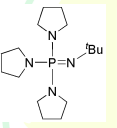
Phosphazene Superbase Identification
This question asks to identify a specific phosphazene compound known for its property as a superbase. Superbases are defined as organic or inorganic compounds with basicity greater than that of common strong bases like hydroxide or alkoxide ions. Phosphazenes, particularly those with specific substituents, can exhibit exceptionally high basicity due to factors like charge delocalization and the nature of the substituents.
Compound Structure Analysis
The options present different chemical structures of phosphazene derivatives. The correct identification relies on recognizing the structural features that contribute to superbasicity. The structure shown in Option 3 corresponds to a linear diphosphazene compound, specifically one featuring hexakis(dialkylamino) substitution, such as P2(NR2)6. A common example is P2(NMe2)6, which is recognized as a potent superbase due to the electron-donating nature and steric accessibility provided by the amino substituents. This structure allows for effective stabilization of the protonated species, driving the high basicity.
Therefore, the phosphazene compound acting as a superbase is represented by the structure in Option 3.
Important Questions from p Block Elements
Borax on treatment with NaOH and $H_2O_2$ forms X. The compound X on reaction with PhCN at $60$ °C in methanol-water mixture gives Y as the major product.
X and Y, respectively, are- The reaction of $P_2O_5$ with $HNO_3$ and $HClO_4$, respectively, gives
- The ease of formation of the adduct, $NH_3 \cdot BX_3$ (where, $X = F, Cl, Br$) follows the order
- Ammonolysis of $S_2Cl_2$ in an inert solvent gives
- In cyclophosphazenes, $(NPX_2)_3$ (X = F, Cl, Br and Me), the strength of P-N $\pi$-bond varies with X in the order


