The ozonolysis of a hydrocarbon in the presence of water produced pentanoic acid and carbonic acid. The hydrocarbon is
1‐hexene
Ozonolysis Reaction Overview
Ozonolysis is a chemical reaction used to cleave unsaturated bonds (double or triple bonds) in alkenes and alkynes using ozone ($\text{O}_3$). The products of ozonolysis depend on the type of unsaturated bond and the work-up conditions (usually reductive or oxidative).
In the presence of water ($\text{H}_2\text{O}$), which acts as an oxidative work-up condition, alkenes and alkynes are cleaved at the double or triple bond. For alkenes, this typically yields carboxylic acids, ketones, or aldehydes, depending on the substitution pattern of the double bond. Specifically:
- A terminal $\text{CH}_2=$ group is oxidized to carbonic acid ($\text{H}_2\text{CO}_3$).
- A $\text{R-CH}=$ group is oxidized to a carboxylic acid ($\text{RCOOH}$).
- A $\text{R}_2\text{C}=$ group is oxidized to a ketone ($\text{R}_2\text{CO}$).
For alkynes, ozonolysis can lead to carboxylic acids or dicarbonyl compounds, depending on the conditions. Terminal alkynes can yield a carboxylic acid and $\text{CO}_2$ or formic acid.
Analyzing the Products: Pentanoic Acid and Carbonic Acid
The products given are pentanoic acid and carbonic acid.
- Pentanoic acid: This is a 5-carbon carboxylic acid ($\text{CH}_3\text{CH}_2\text{CH}_2\text{CH}_2\text{COOH}$). This suggests that one part of the original unsaturated hydrocarbon chain contained 4 carbon atoms attached to the carbon that became the carboxyl group.
- Carbonic acid: ($\text{H}_2\text{CO}_3$) This product is characteristic of the oxidative cleavage of a terminal $\text{CH}_2=$ group in an alkene during ozonolysis.
Based on these products, the original hydrocarbon must contain a double bond, and one end of the double bond must be a terminal $\text{CH}_2=$ group, and the other end must be a $\text{-CH-}$ group attached to a 4-carbon chain.
Evaluating the Hydrocarbon Options
Let's examine each given hydrocarbon option and predict the products of ozonolysis in the presence of water.
- 1-hexene: The structure is $\text{CH}_2=\text{CHCH}_2\text{CH}_2\text{CH}_2\text{CH}_3$.
The double bond is between $\text{C}1$ and $\text{C}2$. The $\text{CH}_2=$ group ($\text{C}1$) will yield carbonic acid ($\text{H}_2\text{CO}_3$). The $\text{-CHCH}_2\text{CH}_2\text{CH}_2\text{CH}_3$ group ($\text{C}2$ onwards) will yield $\text{CH}_3\text{CH}_2\text{CH}_2\text{CH}_2\text{COOH}$ (pentanoic acid). Ozonolysis of 1-hexene gives pentanoic acid and carbonic acid. This matches the given products.
- 1-hexyne: The structure is $\text{CH}\equiv\text{CCH}_2\text{CH}_2\text{CH}_2\text{CH}_3$.
This is a terminal alkyne. Ozonolysis of terminal alkynes typically yields a carboxylic acid and $\text{CO}_2$ or formic acid, not carbonic acid directly in this manner. The products would likely be pentanoic acid and $\text{CO}_2$ or formic acid.
- 5-decene: This is an internal alkene. For example, $\text{CH}_3\text{CH}_2\text{CH}_2\text{CH}_2\text{CH}=\text{CHCH}_2\text{CH}_2\text{CH}_2\text{CH}_3$.
The double bond is internal. Ozonolysis would cleave the double bond, yielding two carboxylic acids. In this case, each side of the double bond is a pentyl group attached to the $=\text{CH}$ carbon. The products would be two molecules of pentanoic acid ($\text{CH}_3\text{CH}_2\text{CH}_2\text{CH}_2\text{COOH}$). Carbonic acid would not be produced.
- 5-decyne: This is an internal alkyne. For example, $\text{CH}_3\text{CH}_2\text{CH}_2\text{CH}_2\text{C}\equiv\text{CCH}_2\text{CH}_2\text{CH}_2\text{CH}_3$.
The triple bond is internal. Ozonolysis would cleave the triple bond, yielding two carboxylic acids. Similar to 5-decene, the products would be two molecules of pentanoic acid ($\text{CH}_3\text{CH}_2\text{CH}_2\text{CH}_2\text{COOH}$). Carbonic acid would not be produced.
Conclusion
Comparing the predicted products with the given products (pentanoic acid and carbonic acid), only the ozonolysis of 1-hexene in the presence of water yields both products. The terminal double bond ($\text{CH}_2=$) breaks to give carbonic acid, and the other part ($\text{-CHCH}_2\text{CH}_2\text{CH}_2\text{CH}_3$) breaks to give pentanoic acid.
The reaction for 1-hexene can be written as:
\(\text{CH}_2=\text{CHCH}_2\text{CH}_2\text{CH}_2\text{CH}_3 \quad \xrightarrow[\text{H}_2\text{O}]{\text{O}_3} \quad \text{H}_2\text{CO}_3 + \text{CH}_3\text{CH}_2\text{CH}_2\text{CH}_2\text{COOH}\)
Therefore, the hydrocarbon is 1-hexene.
Important Questions from Named Reactions
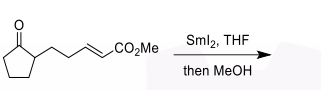
Among the given options, the possible product(s) that can be obtained from the following reaction is/are
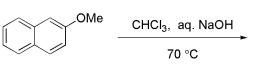
The major product in the following reaction sequence is
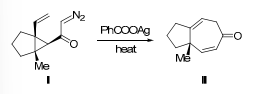
Formation of the ketone II from the diazoketone I involves
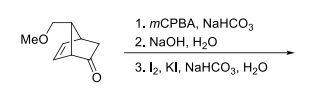
The major product formed in the following reaction is
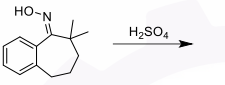
The major product formed in the following reaction is