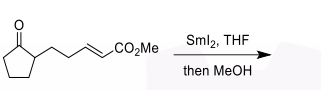
Formation of the ketone II from the diazoketone I involves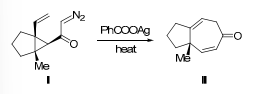
The question involves the conversion of diazoketone I to ketone II, and we need to determine the reaction mechanism. Let's analyze the transformation step-by-step:
- The starting compound I is a diazoketone. Under thermal conditions with silver benzoate (PhCOOAg), diazoketones typically undergo Wolff rearrangement. This includes the generation of a ketene intermediate.
- In the Wolff rearrangement, diazoketones lose nitrogen gas to form a carbene, which can rearrange to produce a ketene. The formation of the ketene confirms the presence of this intermediate.
- Once the ketene is formed, it undergoes a [3,3]-sigmatropic rearrangement known as Claisen rearrangement, which is characterized by the reorganization of bonds leading to a new ketone structure.
Thus, the correct reaction pathway involves the generation of ketene followed by a [3,3]-sigmatropic rearrangement.
Therefore, the correct answer is: generation of ketene and a [3,3]-sigmatropic rearrangement.
Let's rule out other options:
- Generation of carbene and a [2,3]-sigmatropic rearrangement: Incorrect because the [2,3]-rearrangement is not typically associated with this type of reaction.
- Generation of carbene and an electrocyclic ring closing reaction: Incorrect as electrocyclic reactions do not apply to this mechanism.
- Generation of ketene and a [2+2] cycloaddition: Incorrect because the product structure is not formed by [2+2] cycloaddition.
Important Questions from Named Reactions
The ozonolysis of a hydrocarbon in the presence of water produced pentanoic acid and carbonic acid. The hydrocarbon is
Among the given options, the possible product(s) that can be obtained from the following reaction is/are
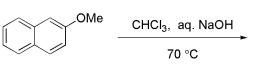
The major product in the following reaction sequence is
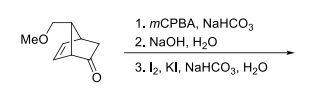
The major product formed in the following reaction is
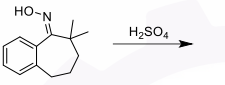
The major product formed in the following reaction is