
The negative edge triggered JK flip-flop in the Figure has J and K inputs tied to Logic High and a square wave of 10 cycles/second is applied to its clock (C) input.
The frequency of the output Q (in cycles/second) is __.
(rounded off to two decimal places)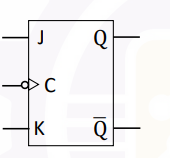
The JK flip-flop shown has its J and K inputs connected to Logic High, making it toggle on every negative edge of the clock cycle. Given a clock frequency of 10 cycles/second, we can determine the output frequency, Q, by understanding the toggling behavior.
Step-by-step Solution:
- The JK flip-flop will toggle its output on each negative edge of the clock signal.
- With the clock frequency at 10 Hz, there are 10 negative edges per second.
- Each toggle event occurs on a negative edge, meaning the output frequency Q is half the clock frequency:
Output Frequency (Q) = Clock Frequency / 2 = 10 Hz / 2 = 5 Hz
Thus, the frequency of the output Q is 5.00 cycles/second.
Validation:
The computed frequency of 5.00 cycles/second clearly falls within the provided range of 4.9 to 5.1, confirming its accuracy.
Important Questions from Flip-Flop
In D flip-flop, if D = 1, then the output of the D flip-flop is ______, but if D = 0, then the output of D flip-flop goes to ______ state.
Which of the following statements about the T-type flip-flop is correct?
I. If T = 1, Changes the state of the lining clock pulse.
II. If T = 0, the state does not change.
For a JK Flip‐flop
A. When J = 0, K = 1, Q n+1 = 0
B. When J = 1, K = 1, Q n+1 = 1
C. When J = 1, K = 1, Q n+1 =\(\rm \overline{Q_n}\)
D. When J = 1, K = 0, Q n+1 = 1
E. When J = 1, K = 0, Q n+1 = 0
Choose the correct answer from the options given below:
Which of the following pair is/are correct?
I. Astable multivibrator - Flip Flop
II. Bistable multivibrator - Free running
Toggle condition is present in which of the following?


