
Consider the given circuit. In this circuit, the race around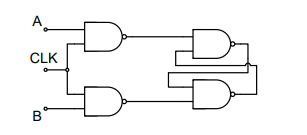
To determine whether a race around condition occurs in the given circuit, we need to analyze the functionality of the typical digital logic circuit involved. The diagram in the question depicts a JK flip-flop circuit. A race around condition typically occurs in JK flip-flops when both inputs J and K are high (i.e., J = K = 1) and the clock signal is also high, causing the output to toggle continuously if the clock pulse width is longer than the flip-flop transition time.
- Identify the Components: The key components of a JK flip-flop circuit are two NAND gates configured to allow toggling when both J and K inputs are high.
- Evaluate the Conditions:
- Race around condition occurs when J = K = 1 and the clock (CLK) is high. This causes the output to toggle between 0 and 1 rapidly.
- If J and K inputs are not both high, the race around cannot occur. Similarly, if the clock is low, there is no change in state.
- Analyze the Given Options:
- Option 1: does not occur - This means the circuit is designed such that the race around condition is prevented under all circumstances.
- Option 2: occurs when CLK = 0 - If the clock is at a low state, flip-flops do not change state, hence no racing around.
- Option 3: occurs when CLK = 1 and A = B = 1 - This condition aligns with when a race around can occur if A and B equate J and K both being 1. However, if such a situation were possible, the race condition would occur, unless proper edge-triggering or master-slave design is implemented.
- Option 4: occurs when CLK = 1 and A = B = 0 - With inputs being low, J and K (treated as A and B here) do not initiate the race as toggling requires them to be high.
- Conclusion: Based on the JK flip-flop's operation and what prevents race conditions (such as edge-triggered or master-slave designs), the correct answer is "does not occur." The circuit likely uses design approaches that inherently avoid race conditions regardless of the specific input states, confirming the safe operation stated in the answer without any race around being possible.
Important Questions from Flip-Flop
In D flip-flop, if D = 1, then the output of the D flip-flop is ______, but if D = 0, then the output of D flip-flop goes to ______ state.
Which of the following statements about the T-type flip-flop is correct?
I. If T = 1, Changes the state of the lining clock pulse.
II. If T = 0, the state does not change.
For a JK Flip‐flop
A. When J = 0, K = 1, Q n+1 = 0
B. When J = 1, K = 1, Q n+1 = 1
C. When J = 1, K = 1, Q n+1 =\(\rm \overline{Q_n}\)
D. When J = 1, K = 0, Q n+1 = 1
E. When J = 1, K = 0, Q n+1 = 0
Choose the correct answer from the options given below:
Which of the following pair is/are correct?
I. Astable multivibrator - Flip Flop
II. Bistable multivibrator - Free running
Toggle condition is present in which of the following?


