
A flip-flop is capable of storing ______ information.
1 bit
Understanding Flip-Flop Information Storage
A flip-flop is a fundamental building block in digital electronics, specifically in sequential logic circuits. Its primary function is to store a single bit of binary information. This makes it a one-bit memory cell.
What is a Bit?
A bit is the most basic unit of information in computing and digital communications. It represents a binary state, which can be either 0 or 1.
- A single flip-flop circuit is designed to hold one of these two states at any given time.
- This inherent characteristic defines the storage capacity of a basic flip-flop.
Comparing Storage Units
Let's compare a bit with the other options provided:
| Unit | Amount of Information | Relation to Bits |
|---|---|---|
| Bit | A single binary state (0 or 1) | 1 bit |
| Nibble | A collection of 4 bits | 4 bits |
| Byte | A collection of 8 bits | 8 bits |
| Byte Word | A term describing a group of bytes processed together, often 2, 4, or 8 bytes depending on system architecture. | Significantly more than 1 bit (e.g., 16, 32, or 64 bits) |
As the table shows, a bit is the smallest unit of digital information. A flip-flop is capable of holding exactly this amount – a single binary digit, or 1 bit.
Why Other Options Are Incorrect
- 1 byte: A byte consists of 8 bits. Storing 1 byte requires multiple flip-flops (typically 8 flip-flops arranged in a register). A single flip-flop cannot store 8 bits.
- 1 byte word: A byte word is even larger than a single byte, representing multiple bytes. Storing a byte word would require many flip-flops grouped together.
- 1 nibble: A nibble is 4 bits. Storing 1 nibble requires 4 flip-flops. A single flip-flop cannot store 4 bits.
Therefore, a single flip-flop is specifically designed to store just one bit of information.
Revision Table: Flip-Flop Basics
| Concept | Description |
|---|---|
| Flip-Flop | A sequential logic circuit capable of storing 1 bit of information. |
| Bit | The smallest unit of digital information (0 or 1). |
| Sequential Circuit | A digital circuit whose output depends on both the current input and the previous state (memory). Flip-flops are key components. |
Additional Information: Types and Applications of Flip-Flops
There are different types of flip-flops, such as SR, D, JK, and T flip-flops, each with slightly different input configurations and behavior, but they all share the core function of storing 1 bit.
Flip-flops are essential components used in:
- Registers for storing data words.
- Counters for counting clock pulses.
- Memory circuits (like static random-access memory - SRAM).
- State machines to control sequential operations.
Their ability to store a single bit makes them fundamental memory elements in digital systems.
Important Questions from Flip-Flop
The negative edge triggered JK flip-flop in the Figure has J and K inputs tied to Logic High and a square wave of 10 cycles/second is applied to its clock (C) input.
The frequency of the output Q (in cycles/second) is __.
(rounded off to two decimal places)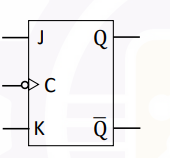
Race Around condition can be avoided in Digital logic circuits using _______.
Consider the given circuit.
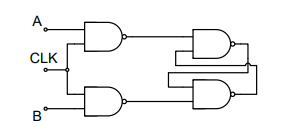
In this circuit, the race around
What is the characteristic of a master-slave flip-flop?
Which of the following pair is/are correct?
I. Astable multivibrator - Flip Flop
II. Bistable multivibrator - Free running


