
Interpreting Geological Lineations: Bedding and Cleavage
The question describes a specific geometric relationship observed in deformed rocks: the intersection between bedding surfaces and upright slaty cleavage results in a horizontal lineation. We need to determine the type of folding responsible for this observation.
Geometric Analysis
Let's break down the geometry:
- Bedding Surfaces: These represent the original layers of rock. In folded sequences, these surfaces are deformed.
- Upright Slaty Cleavage: This is a secondary fabric (a set of parallel planes) formed during deformation. 'Upright' implies the cleavage planes are oriented vertically. In many cases, slaty cleavage is parallel to the axial plane of folds. Therefore, upright cleavage suggests a vertical axial plane for the folds.
- Horizontal Lineation: This lineation is the trace formed where the bedding surfaces intersect the cleavage planes. The fact that it is horizontal is a key constraint.
Evaluating Fold Types
We examine how different fold types accommodate upright cleavage and generate a horizontal lineation:
- Upright Folds: These have vertical axial planes. If cleavage is parallel to the axial plane, it will be upright.
- Non-plunging Folds: These have horizontal fold axes. The bedding surfaces within these folds typically have a strike parallel to the fold axis (i.e., horizontal) and dip symmetrically away from the axial plane.
- Plunging Folds: These have inclined fold axes.
- Reclined/Recumbent Folds: These have inclined (reclined) or horizontal (recumbent) axial planes, which contradicts the 'upright' nature of the cleavage specified.
Connecting Geometry to Folding
Consider upright non-plunging folds:
- The axial plane is vertical (consistent with upright cleavage).
- The fold axis is horizontal.
- Bedding surfaces are folded symmetrically around the vertical axial plane.
- When a vertical plane (cleavage) intersects inclined bedding surfaces within a non-plunging fold, the intersection line (lineation) is horizontal.
Conversely, consider upright plunging folds: The fold axis is inclined. The intersection of a vertical cleavage plane and the dipping bedding surfaces in such a fold would generally result in an inclined, not horizontal, lineation.
Therefore, the observed horizontal lineation resulting from the intersection of bedding and upright cleavage strongly suggests that the bedding surfaces are folded into upright, non-plunging folds.
Conclusion
The most likely interpretation, given that the intersection of bedding and upright slaty cleavage forms a horizontal lineation, is that the bedding surfaces are folded into upright non-plunging folds.
Important Questions from Folds
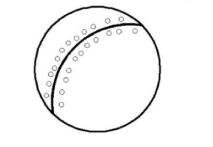
The following figure shows the lower hemisphere, equal area plots of the poles to bedding surfaces. Which one of the following is the correct interpretation?
Figures A and B show two cross-sections of a folded sandstone bed.
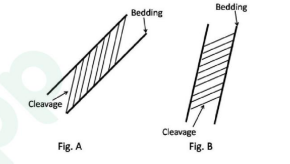
Which one of the following is the correct interpretation of the Figs. A and B?
Match the outcrop patterns of folds with corresponding types.
Outcrop Patterns Fold A. 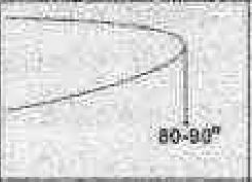
P. Plunging antiform B. 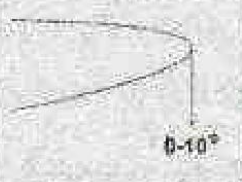
Q. Plunging synform C. 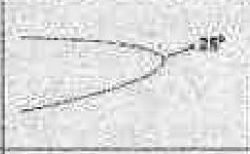
R. Reclined D. 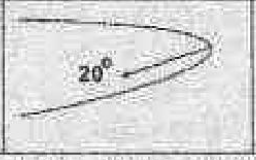
S. Recumbent - Which one of the following is the correct angle between the hinge line and the strike line of the axial plane in a reclined fold?
- The horizontal equivalent, measured between two successive strike lines on a map, for a vertical bed is:


