
The following figure shows the lower hemisphere, equal area plots of the poles to bedding surfaces. Which one of the following is the correct interpretation?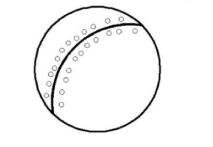
The question involves interpreting an equal area plot of the poles to bedding surfaces, commonly used in structural geology to analyze the orientation and folding of rock layers.
Let's go through the options and reasoning to find the correct answer:
- The beds are folded cylindrically:
A cylindrical fold is characterized by the beds having a consistent axis of fold. In an equal area plot, poles to bedding surfaces would typically align along a great circle, which indicates that the folding is developed around a cylindrical shape.
- The beds are folded non-cylindrically:
Non-cylindrical folds do not have a consistent axis or symmetry. In a stereonet, this would result in a less organized pattern of poles that do not align along a single great circle.
- The beds are folded isoclinally:
An isoclinal fold is very tight, where layers are parallel or nearly parallel to each other. In a stereonet, this would appear as overlapping or closely packed poles, which is not reflected in the plot shown.
- The beds are not folded:
If the beds were not folded, poles would be scattered randomly without any specific alignment in the stereonet.
Based on the given diagram, the poles are aligned along a great circle, suggesting a consistent axis of folding. Hence, the most suitable interpretation is that the beds are folded cylindrically.
Conclusion: The correct interpretation is that the beds are folded cylindrically.
Important Questions from Folds
- The intersection of bedding surface with upright slaty cleavage surface occurs as horizontal lineation. Which one of the following is the most likely interpretation? The bedding surfaces are folded into
Figures A and B show two cross-sections of a folded sandstone bed.
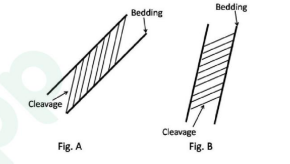
Which one of the following is the correct interpretation of the Figs. A and B?
Match the outcrop patterns of folds with corresponding types.
Outcrop Patterns Fold A. 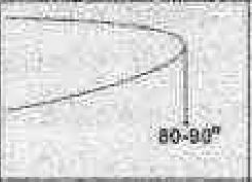
P. Plunging antiform B. 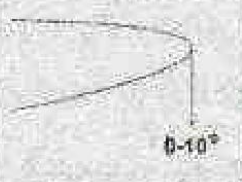
Q. Plunging synform C. 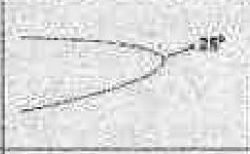
R. Reclined D. 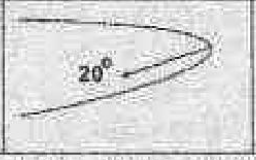
S. Recumbent - Which one of the following is the correct angle between the hinge line and the strike line of the axial plane in a reclined fold?
- The horizontal equivalent, measured between two successive strike lines on a map, for a vertical bed is:


